You ask three providers what a virtual assistant costs. The first quotes R150 an hour. The second sends a glossy PDF with four tiers, none of which match what you actually need. The third says “it depends” and books you for a sales call. By the time you hang up, you know less than when you started, and the only thing you’re certain of is that someone is hoping you won’t read the fine print.
Pricing in this industry has a transparency problem. Not because the work is hard to value, but because most providers have figured out that confusion is profitable. A vague hourly rate hides the fact that you’ll spend a third of those hours managing the person. A rock-bottom monthly figure quietly leaves out the cost of the work you’ll redo. And the comparison most business owners actually need — “what does this cost me versus hiring someone in-house?” — almost never gets laid out honestly, because the honest version makes the in-house option look expensive in a way that’s uncomfortable for everyone selling local recruitment.
So let’s do the uncomfortable version. This is a plain-numbers breakdown of what a virtual assistant in South Africa actually costs in 2026, what sits underneath the sticker price, and why the cheapest quote on the page is almost never the cheapest option you’ll end up paying for.
What South African VAs Actually Cost in 2026
Start with the raw rates, because that’s what everyone wants first.
For businesses hiring South African talent directly, freelance rates land in a fairly consistent band. Local recruitment data puts most South African VAs between R225 and R500 per hour, depending on experience, specialisation, and contract structure. Convert that for international buyers and the picture sharpens: entry-level South African VAs can start as low as $5 to $7 per hour, while highly experienced or specialised ones typically max out around $20 to $25 plus.
Set that against the markets a UK or US business would otherwise look at. A 2026 industry breakdown pegs the US-based VA at $25 to $55 per hour and a Filipino VA through an agency at roughly $6.50 to $17. South Africa sits in the affordable band on price while landing closer to the premium band on the things that actually determine whether the work is usable — English fluency, written communication, and overlap with the UK and European working day.
That combination is the whole pitch. As one South African talent firm frames it, the country offers strong English skills, Western work habits, and a partially overlapping time zone, making it an exceptionally attractive destination for hiring remote talent. You’re not trading quality for cost. You’re buying out of an exchange-rate quirk that lets a UK pound or US dollar buy a genuinely senior professional.
But here’s the first place the transparency problem bites. The hourly rate is the least important number in this entire article. It’s the number providers lead with precisely because it’s the one that looks best in isolation — and the one that conceals the most.
The Hourly Rate Is a Trap (And Here’s Why)
An hourly rate answers exactly one question: what does sixty minutes of someone’s logged time cost? It says nothing about how many of those minutes turn into finished work, how many you’ll spend explaining what you wanted, or how many you’ll spend checking what came back.
This is the trap that sinks first-time buyers. There’s a well-worn observation from the technology community that captures it better than any sales deck. A commenter on Hacker News, reacting to a then-new VA service, put the problem this way:
“It can very easily take more time to explain what you want, verify that you actually got what you wanted and deal with the risk of getting something you didn’t want than just doing it yourself.”
That sentence is the entire reason “cheap” VAs are so often expensive. The risk of spending more time explaining and verifying a task than it would take to simply do it yourself is real, and it scales directly with how unmanaged the relationship is. A R200-an-hour freelancer who needs everything spelled out twice, delivers something adjacent to the brief, and goes quiet for two days is not cheaper than a R350-an-hour professional who gets it right the first time. The first one is more expensive. You just pay the difference in your own hours instead of theirs.
This is why the smart framing has shifted. As one 2026 employer guide on South African hiring puts it, you should price the role based on output, management load, and business risk, not just the cheapest rate someone was willing to quote. The hourly number is an input. The thing you’re actually buying is finished, reliable output — and the gap between those two is where your real budget goes.
So if the hourly rate is a trap, what should you compare instead? The honest answer is the only comparison that matters: a VA against the in-house hire you’re trying to avoid making.
The Comparison Nobody Shows You: VA vs In-House Hire
Most pricing guides stop at “VAs are cheaper than employees” and wave at a percentage. Let’s actually build the number, because the gap is wider than the wave suggests.
Say you hire a capable administrator in South Africa on a salary that, with benefits, you imagine costing you somewhere around R20,000 to R45,000 a month — which is roughly the band one local guide gives for a mid-level hire, excluding benefits. That salary figure is where most people’s mental math stops. It’s also where the real cost starts.
On top of gross salary, a South African employer carries statutory contributions. Employers contribute 1% of an employee’s remuneration to the Unemployment Insurance Fund, matched by the employee’s own 1%. Companies with an annual payroll above R500,000 add the Skills Development Levy at 1% of total payroll, plus workers’ compensation premiums to the Compensation Commissioner that vary by industry risk. Taken together, these statutory payments add roughly 2% on top of an employee’s gross salary to the employer’s total payroll cost.
Two percent sounds trivial, and on its own it is. But statutory contributions are the small, visible tip of the iceberg. The expensive part is everything that doesn’t show up on a payslip: recruitment, onboarding, equipment, software licences, office overhead, paid leave, the 13th cheque South African employees often expect even though it isn’t mandatory, management time, and — the big one — the cost of the hire not working out.
That last item dwarfs everything else. The research on employee turnover is brutal and remarkably consistent. According to Gallup, the cost of replacing an individual employee can range from 50% to 200% of their annual salary, depending on role and seniority. SHRM puts the replacement bill at six to nine months of that person’s salary. For an employee on R30,000 a month, a single bad hire that walks at month four can quietly cost you R90,000 to R180,000 once you count recruitment, the work that stalled, and the months of ramp-up that produced nothing.
A bad in-house hire on a R30,000 monthly salary can cost between half and twice their annual pay to replace — six figures vanishing on one wrong decision, before the role has produced a single result.
And these costs hide. Research from the Work Institute breaks the total down neatly: direct replacement costs are only about 11% of salary, roughly a third of the total, while the remaining 22% reflects hidden but real costs that impact performance, morale, and continuity. Most of what an employee actually costs you is the part you never see on an invoice — which is exactly why the in-house comparison feels cheaper than it is.
Now hold that next to a managed VA arrangement. There’s no recruitment cost, because the provider has already hired. No onboarding gamble, because the model includes vetting and training. No equipment, no office, no statutory payroll administration, no 13th-cheque expectation landing on your books, and — critically — no turnover bomb, because if the person isn’t working out, replacing them is the provider’s problem and the provider’s cost, not yours. The headline rate might look similar to a salary. The total cost of ownership isn’t in the same postcode.
This is where the “up to 60% saving versus a local in-house hire” figure comes from. It isn’t a discount on an hourly rate. It’s what happens when you stop paying for the entire invisible scaffolding that surrounds an employee and pay only for the work.
The Three Pricing Models, Decoded
Once you’ve decided a VA beats an employee, you hit the next wall of confusion: providers price the same service three completely different ways. Here’s what each model actually means for your budget.
Hourly. You pay for logged time. It feels precise and it suits genuinely sporadic, unpredictable work — a few hours here, a burst there. The problem is everything covered above: you’re buying minutes, not outcomes, and you carry all the management and verification load yourself. Hourly also creates a quiet incentive misalignment. If a freelancer is paid by the hour, a task that takes longer pays better, which is precisely the wrong thing to reward.
Monthly / retainer. You buy a block of hours or a set commitment each month at a per-hour rate that’s usually lower than ad-hoc. This stabilises your budget and tends to produce a better working relationship, because the person isn’t juggling you against five other clients by the hour. Full-time arrangements provide stability for both parties and can result in a lower cost per hour. The risk is paying for hours you don’t use, or under-buying and constantly topping up.
Managed. This is the model that confuses people on price because, on a pure rate basis, it can look more expensive than a bare freelancer — and then turns out to be cheaper in practice. In a managed arrangement you’re not just renting a person’s hours. You’re buying the vetting, the training, the performance management, the accountability structure, and the replacement guarantee. The provider absorbs the risk that a freelancer leaves entirely on your shoulders.
The distinction matters enormously, and the industry’s own history proves it. Zirtual, a well-funded US VA startup, abruptly told its customers in 2015 that it was “pausing all operations” due to a combination of market circumstances and financial constraints, having employed more than 400 assistants. Customers who’d built their week around a Zirtual assistant woke up with nothing. A managed provider with a stable model and a replacement structure exists precisely so that a single point of failure — one person quitting, one provider stumbling — doesn’t take your operations down with it.
The cheapest pricing model on paper is the one most likely to disappear on you. Resilience is a line item, even when no invoice names it.
Why “Cheap” Costs More: The Hidden Bill
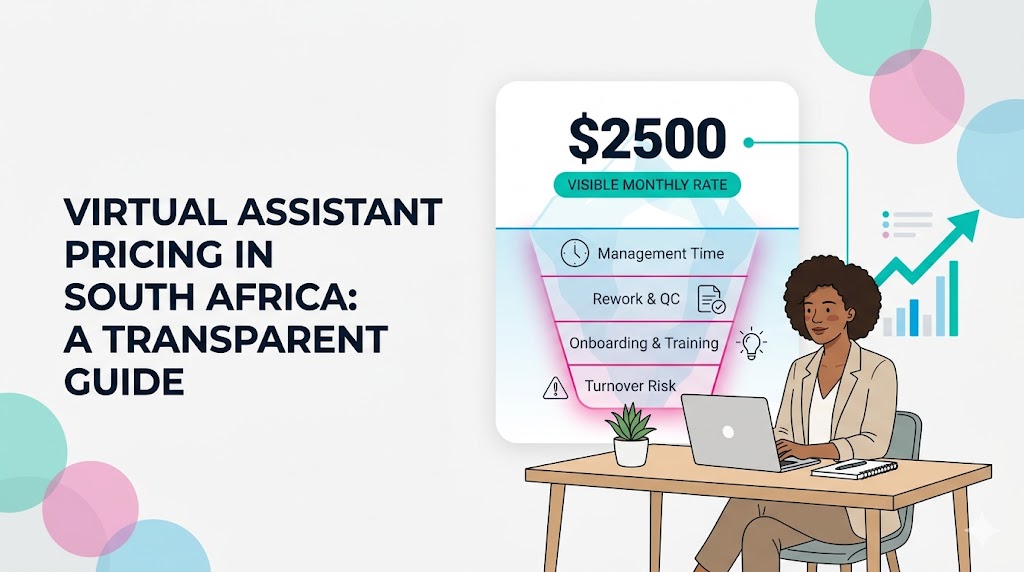
Pull the threads together and the real cost of a VA looks nothing like the hourly rate. There’s a layer of expense underneath every cheap quote, and you pay it whether or not anyone itemises it.
There’s the verification tax — the time you spend checking and redoing work that came back wrong, which the Hacker News commenter identified as the thing that can make a cheap VA cost more than doing the job yourself. There’s the management load, the 15 to 30% of your own week that quietly evaporates into briefing, chasing, and correcting an unmanaged freelancer. There’s the churn risk, the freelancer who vanishes mid-project the way the Coursera contractor in one widely shared account was abruptly cut loose, or the way Zirtual’s whole roster evaporated overnight. And there’s the opportunity cost — every hour you spend managing a cheap VA is an hour you’re not spending on the work only you can do.
None of these appear on an hourly invoice. All of them are real money. The genuinely cheap option isn’t the lowest rate; it’s the arrangement where these hidden bills are smallest. Usually that’s the managed one, because the entire point of the managed model is to move those costs off your plate and onto the provider’s.
The South African Advantage on Price
Here’s where South Africa stops being merely affordable and starts being structurally smart — particularly for UK and European businesses.
The cost advantage is straightforward and runs on the exchange rate. A UK or US business pays South African professionals a rate that’s a fraction of a local in-house salary, while the professional earns a strong wage in rand. One South African hiring platform markets exactly this: save 70% on hiring costs and connect with top-tier experts ready to work in your timezone. That’s not a discount on quality. It’s an arbitrage on geography.
But price without overlap is a false economy, and this is where South Africa pulls ahead of the cheaper Asian markets. South African working hours sit on GMT+2, which means a near-complete overlap with the UK and European business day and a workable overlap with the US East Coast. A Philippines-based VA at a lower hourly rate often works your night to match your day, which introduces a lag into every back-and-forth. With South Africa, you ask a question at 10am and get an answer at 10:15am, not at midnight. The time zone is part of the value, not a footnote to it.
Then there’s the quality of the communication itself, which is where so much of the hidden verification cost gets eliminated before it starts. South African professionals bring excellent written and spoken English, Western culture compatibility, and time zone overlap with the UK, Europe, and parts of the US, supported by a favourable exchange rate that offers excellent value without sacrificing quality. When the person you’re delegating to writes in fluent, idiomatic English and understands the cultural context of your business, you simply don’t pay the re-explanation tax that makes cheaper-on-paper options expensive in practice.
So the South African advantage on price isn’t really about the lowest rate. It’s that the rate is genuinely competitive and the hidden costs that inflate every other option are structurally smaller. You’re not choosing between cheap and good. You’re getting the rare arrangement where the affordable option is also the one that produces less rework.
How VAConnect Prices: Managed, Not Matched
This is where it’s worth being upfront about how VAConnect approaches the question, because the model is the whole answer to the transparency problem this article opened with.
VAConnect doesn’t run a marketplace where you scroll through profiles, pick the cheapest hourly rate, and hope. The model is Managed, Not Matched — and the distinction is precisely the difference between the cheap-on-paper trap and the genuinely-cheaper reality described above. Founded in 2008 (originally as Lime Tree Consulting, rebranded to VAConnect when it became a managed virtual assistant business in 2014), the company has delivered over 250,000 hours of work, runs a team of 35-plus professionals, and has accumulated, by its own published count, just two bad reviews across that history.
What you’re paying for in that managed model is everything that lives in the hidden-bill section above, handled for you. There’s VAVarsity, the company’s own continuous-training platform that keeps assistants upskilled rather than static. There’s the Two-Way Happiness programme (VAPI), an accountability structure that manages the working relationship in both directions — so the person stays engaged and you stay informed, which is exactly the management load you’d otherwise carry yourself. And the founder’s own story matters here: Karen van Zyl built the company having run businesses herself, which is why the model is designed around an entrepreneur’s actual pain — not adding HR headaches while you try to grow.
The price you pay for a managed arrangement reflects that the verification tax, the management load, and the churn risk have been engineered out of the deal rather than quietly passed to you. On a pure hourly comparison against a bare freelancer, that can look like more. Measured against the in-house hire it actually replaces — with its statutory contributions, its 13th cheque, its onboarding gamble, and its six-figure turnover risk — it’s the cheaper option by a wide margin. That’s the comparison that should drive the decision, and it’s the one most providers hope you’ll never run.
The Honest Bottom Line
Pricing a virtual assistant well comes down to refusing the one number everyone wants you to fixate on. The hourly rate is a starting point, not an answer. The real cost is what you pay to get reliable, finished work — and that figure includes your management time, your rework, your churn risk, and the opportunity cost of every hour you spend supervising instead of building.
Run honestly, the comparison isn’t close. A South African managed VA gives you fluent communication, a working-day time zone overlap with the UK and Europe, and a rate that undercuts a local in-house hire — while removing the statutory costs, the onboarding gamble, and the turnover risk that make employees so much more expensive than their salaries suggest. The cheap freelancer wins on the invoice and loses everywhere the invoice doesn’t look.
If you want to see what that looks like in real numbers for your specific situation, the most useful next step is a transparent conversation rather than a glossy tier chart. See VAConnect’s pricing and book a strategy-first call to map the actual cost of the work you need done — not the sticker price of the hours.
Sources
- RecruitMyMom — Virtual Assistant Rates in South Africa: What You Should Expect to Pay in 2025
- HireSava — Comprehensive Guide to Virtual Assistant Salaries in South Africa and How Much Does a Virtual Assistant Cost in South Africa (Employer Guide, 2026)
- MEXC / industry pricing breakdown — How Much Does It Really Cost to Hire a Virtual Assistant in 2026
- openHR — UIF Rates and Thresholds 2025; globalli.io and Playroll — Employer Costs for Hiring in South Africa (2025–2026); Borderless AI — How Much Does it Cost to Hire an Employee in South Africa
- Gallup / SHRM via Forma and Work Institute — The True Cost of Employee Turnover / Replacement Costs (50–200% of salary; 11% direct vs 22% hidden split)
- Hacker News (FancyHands / Perssist discussion threads) — practitioner sentiment on verification cost and freelance churn
- TechCrunch — Virtual Assistant Startup Zirtual Is “Pausing All Operations”
- VAConnect (vaconnect.co.za) — company data: founded 2008 / managed model since 2014, 250,000+ hours, 35+ team, 2 bad reviews, VAVarsity, Two-Way Happiness / VAPI, founder Karen van Zyl, GMT+2 overlap, Managed-Not-Matched model