There is a particular kind of silence that follows a hiring decision. You have signed the contract. You have transferred the deposit. You have a name, maybe a headshot, and a vague promise that someone, somewhere, is now “your assistant.” And then nothing happens for a while, and you start to wonder what exactly you have paid for.
Anyone who has hired help before knows the feeling that comes next. The new person logs in, asks where the files are, asks who approves what, asks how you like your inbox sorted, and asks again the next day because the first answer did not stick. You begin to suspect that delegating has somehow created more work than it removed. You are now managing a person and doing your own job, and the math is not improving.
That gap — between the moment you decide to hire and the moment the hire actually makes your life easier — is where most outsourcing dies. It is also the part almost nobody talks about when they sell you on virtual assistance. The brochures promise time back. They rarely explain how the time gets handed over.
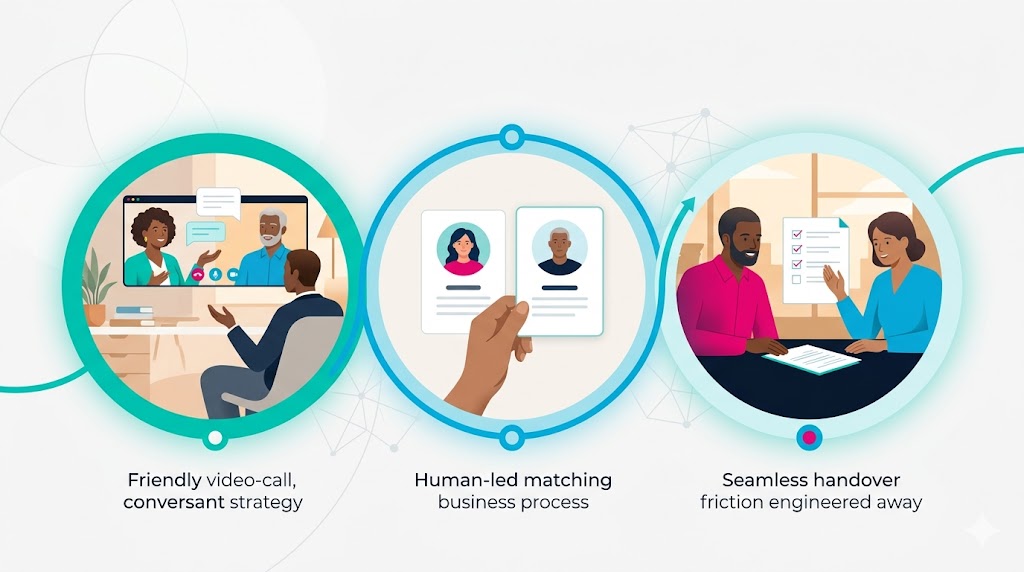
This is a piece about that handover. Specifically, it is about how VAConnect structures the first stretch of a working relationship into three deliberate steps — Strategy First, the Match, and Meet and Start — and why a managed process built over seventeen years tends to beat the “here’s a freelancer, good luck” model that still dominates the market. The difference is not glamorous. It is process. But process, it turns out, is the whole game.
The Onboarding Tax Nobody Puts on the Invoice
Let’s begin with the uncomfortable number. When companies bring on a new hire, the person does not arrive at full output. They arrive at a fraction of it and climb slowly. According to Zippia, new hires operate at a quarter of their full productivity during the first 30 days, with productivity generally increasing another 25% each subsequent month. Multiply that across an entire ramp period and the cost is real, even if it never shows up as a line item.
How long is that ramp? Longer than most people assume. The average ramp time is still six to eight months, with managers spending 15 to 20% of their own time training new hires. Some research stretches the figure further. It takes eight to twelve months for new hires to reach proficiency comparable to their tenured colleagues, yet only 28% of businesses offer onboarding programs lasting even a month.
Read those two facts side by side. Full productivity arrives somewhere around the year mark. Formal onboarding, for most companies, ends in week one. The space between those two timelines is paid for in confusion, repeated questions, half-finished work, and a manager’s attention bleeding away from the things only the manager can do.
The math that should worry you: if a new hire reaches full proficiency in 8–12 months but your onboarding effectively ends after a week, you are not saving time. You are pre-paying for months of supervision and calling it delegation.
The picture gets worse for remote roles, which is exactly the category most virtual assistants fall into. Remote employees report feeling undertrained at a rate of 63% compared to 52% for in-person employees. Distance amplifies every weakness in an onboarding process. You cannot lean over a desk to correct a misunderstanding. The ambiguity that an office quietly resolves through overheard conversations and casual proximity has to be made explicit, on purpose, in writing — or it festers.
And the cost of getting this wrong is not just slow output. It is people leaving. 20% of employees who quit do so in the first 45 days of their job, often because the expectations set during hiring never matched the reality of the work. Nearly 30% of new hires depart within their first 90 days. When that happens, you do not just lose the person. You lose every hour you poured into teaching them, and you start the whole exhausting cycle again.
This is the tax that never appears on the invoice. It is the real price of “just hire someone and figure it out.” VAConnect’s entire argument is that the tax is optional — that a properly engineered onboarding sequence shrinks the ramp, protects the relationship, and turns the first few weeks from a liability into a head start.
Managed, Not Matched: Why the Marketplace Model Breaks Down at the Handover
To understand the three steps, you first have to understand what they are an alternative to.
The dominant way to hire a virtual assistant today is the marketplace. You post a job on a platform, you receive a flood of applications, you scan profiles, you run a few interviews, you pick someone, and from that moment forward, you are entirely on your own. The platform took its cut for making the introduction. Everything after the introduction — the training, the quality control, the awkward conversation when work slips, the scramble when your assistant vanishes mid-project — is yours to manage.
This is what VAConnect means by the distinction at the heart of its model: managed, not matched. A marketplace matches. It connects a buyer to a seller and steps back. A managed agency stays in the room.
The difference shows up most sharply during onboarding, because onboarding is precisely the moment the marketplace abandons you. There is a reason this is a known sore point among people who hire freelancers. As one practitioner put it when weighing up a first remote hire, the worry is whether the beginning is a lot of hand-holding since it is virtual and not in your space to see what you want them to be doing, and whether that learning curve takes some time. Her honest expectation: that hiring would actually add more work to her plate in the beginning.
That instinct is correct, and it is the marketplace model’s fatal flaw. Freelancer onboarding is treated as an afterthought across the industry. As one agency consultant observes, most organizations waste money by forcing freelancers to find their own footing, putting little to no thought into the onboarding process, which leads to time and money being wasted on inefficient or nonexistent systems that should have been designed ahead of time.
“Most organizations waste money by forcing freelancers to find their own footing.” The pain is not the talent. It is the absence of a process around the talent.
VAConnect was built specifically around the part everyone else skips. We take care of the recruitment, onboarding, and management of your VA, allowing you to seamlessly integrate them into your workflow. The company has been refining this since 2008 — first as Lime Tree Consulting, then rebranded in 2014 when it became a managed virtual assistant business — and the whole point of that managed layer is to absorb the friction that would otherwise land on you. The mission is to empower entrepreneurs and business owners to grow and scale their business without growing their HR headaches.
There is also hard evidence that the managed approach to remote onboarding works. A study from TinyPulse found that companies with an established onboarding process retain 91% of their remote workers after the first year. Retention and onboarding are two ends of the same rope. Pull one and the other moves.
So the three steps below are not a generic checklist. They are the operational expression of “managed, not matched” — the specific mechanism by which VAConnect refuses to leave you alone at the handover.
Step One: Strategy First
Everything starts with a conversation, and the order of that conversation matters more than it sounds.
VAConnect begins with a “Strategy First” approach — a quick Zoom or Hangout meeting to discuss fit and strategy. It is worth pausing on the word first. Most hiring processes are role-first: here is a job description, find me a body that fits it. Strategy First inverts that. Before anyone talks about candidates, the conversation is about your business — what you are actually trying to achieve, where your time is leaking, which tasks are stealing your attention from the work only you can do.
This is the diagnostic step. It is the difference between a tailor who measures you and one who hands you a suit off the rack and hopes. The reason it works is that the most expensive onboarding failures are not skill failures. They are fit failures — someone competent dropped into a context they were never set up to understand. When new hires feel that expectations set during hiring are not met, they are likely to see themselves out, and the seeds of that mismatch are almost always planted before day one, in a conversation that either happened properly or did not.
Strategy First also does something subtle for you, the client. It forces a useful kind of clarity. Many business owners have never actually articulated what they want off their plate; they just know they are drowning. The discovery conversation turns that vague drowning feeling into a specific, delegable list. VAConnect’s team takes the time to understand your specific needs and the role you are actually trying to fill — and that act of articulation is half the value before a single candidate is named.
Strategy First is not a sales call. It is the first hour of work. The clarity you gain about your own bottlenecks is worth the meeting on its own.
Practically, this step moves fast. VAConnect typically presents one to two hand-picked candidates within five to seven business days of the strategy call, which means the diagnostic does not become a bottleneck of its own. It is thorough without being slow — the kind of thoroughness that pays for itself in every week that follows.
Step Two: The Match — Hand-Picked, Not Algorithm-Sorted
Once VAConnect understands the shape of the work, the second step is finding the person to do it. And here the contrast with the marketplace model is at its starkest.
VAConnect matches you with a remote assistant based on your needs and requirements, but also someone who will fit your work culture — and the company is openly emphatic about culture. This is not personality-test theatre. Culture fit, in a remote relationship, is the thing that determines whether your assistant anticipates what you need or merely waits to be told. It is the difference between a tool and a teammate.
What makes the match credible is what sits behind it. Every candidate VAConnect presents has already been through a pipeline you never see. Every VA is sourced through VAJobs.co.za, trained through VAVarsity.co.za, monitored for performance and wellbeing via Atomic Energy, and held accountable through VAPIness. By the time a name reaches you, it has passed through sourcing, skills-testing, and vetting. The talent pool is pre-vetted — no unfiltered applicants reach you, candidates are skills-tested and background-checked before matching, and placement is faster because your VA is sourced from a ready pipeline.
Then comes the part that genuinely separates the managed model from the platform: a human chooses. VAConnect does not run an algorithm — every match is personally reviewed before it reaches you. On the UK side of the business the company makes the same promise even more bluntly: no generic intake forms, no algorithm matching — every placement is personal, and instead of a shortlist of twenty, you are presented one or two hand-picked candidates and you choose.
Think about what that does to your time. A marketplace hands you twenty profiles and a research project. The managed model hands you a decision — two strong options, both pre-qualified, both culture-checked, presented by someone who sat through your Strategy First call and understood what you actually need. You are choosing between good and good, not sifting good from noise.
This is also where one of VAConnect’s quieter assets does its work: the Talent Discovery programme, the system that builds a role around your real needs rather than forcing your needs into a pre-existing job slot. In one documented engagement, software engineers and a project manager were placed through VAConnect’s Talent Discovery system, with each candidate pre-vetted for technical capability and culture fit before being presented, and the firm supplied CVs continuously until the client found their exact-match fit. Continuously, until the fit is exact. That is the managed difference stated plainly.
Step Three: Meet and Start — The SOP That Turns a Stranger Into a Teammate
The third step is where most relationships either click into place or quietly fall apart, and it is the step VAConnect engineers most deliberately.
In the “Meet and Start” step, you are introduced to your match, you discuss tasks and KPIs together, and all communication channels are opened between you and your new team member. On the surface, that reads like a friendly handshake. Underneath it is something far more structural.
The mechanism that makes this step work is documentation. VAConnect builds a custom SOP — a Standard Operating Procedure — during onboarding, so your VA has clear processes from day one. This single artefact is the antidote to the entire onboarding tax described earlier. Remember the core problem with remote onboarding: the ambiguity an office resolves through proximity has to be made explicit on purpose. The SOP is that explicitness, written down. It is where “how I like my inbox sorted” stops being a question your assistant asks every Tuesday and becomes a documented process they follow without prompting.
The payoff is speed, and it is dramatic when set against the industry baseline. Recall that the average new hire takes six to eight months to ramp, with some research pushing full proficiency to the year mark. Against that backdrop, VAConnect’s timeline is almost startling. Most clients see meaningful output within the first week, and full ramp-up — where the VA is operating independently and proactively — typically takes two to four weeks depending on role complexity.
Two to four weeks to full ramp, against an industry average of eight months. That is not a marginal improvement. That is a different category of experience.
That gap is not luck. It is the direct result of the first two steps feeding the third. Strategy First means the SOP is built around the right work. The Match means the person executing it already fits the context. By the time you reach Meet and Start, most of the friction has been engineered out upstream — which is exactly why the downstream ramp is so short.
And the support does not switch off once you are running. VAConnect conducts monthly performance reviews and proactively flags issues before they become your problem. The onboarding does not end at week one and leave you to manage the long, fragile middle. It continues, which is precisely what the research says effective onboarding requires. The best onboarding programs extend throughout the first 90 days and may extend to a full year to ensure new hires are fully supported. VAConnect’s monthly cadence is built for that long tail, not just the opening handshake.
The Human in the Loop: Why a Managed Relationship Beats a Self-Service Tool
It is worth naming the temptation that hovers over this entire conversation in 2026. Why bother with a human-managed onboarding process at all? Why not automate it? The onboarding software market is booming for exactly this reason. The global onboarding software market is projected to grow from $1.77 billion in 2024 to $2.12 billion in 2025, with fast-rising demand for AI and automation. Surely a self-service platform with a slick automated intake can do what a managed agency does, faster and cheaper.
Here is the problem with that logic. Automation is excellent at the parts of onboarding that are about information transfer — forms, access provisioning, document delivery. It is close to useless at the parts that are about judgement and relationship, which happen to be the parts that determine whether the hire actually works.
Consider what the three steps actually involve. Strategy First requires someone to listen to a business owner describe a mess and intuit the real bottleneck beneath the stated one. The Match requires a human to weigh culture fit, to feel whether two working styles will mesh — a judgement no algorithm makes well, which is why VAConnect refuses to run one and reviews every match personally. Meet and Start requires building an SOP that captures not just what you want done but the unspoken standards behind it. None of these are information problems. They are human problems.
This is the deeper meaning of “the human in the loop.” It is not nostalgia for doing things the slow way. It is a clear-eyed recognition that the highest-leverage parts of onboarding — diagnosis, fit, and the translation of tacit expectations into explicit process — are exactly the parts that resist automation. A self-service tool leaves all of that to you, the client, which is just the marketplace problem wearing a friendlier interface. You still end up doing the judgement work yourself.
There is a wellbeing dimension to this too, and it is not soft. Remote work fails most often not at the start but in the lonely, unsupported middle, when an isolated worker quietly disengages. VAConnect’s answer is to keep humans watching. The Atomic Energy programme proactively monitors workload, wellbeing, and engagement, because burnout is the silent killer of VA performance. Layered on top is the two-way accountability framework: a Two-Way Happiness Programme that manages the happiness factor of both clients and remote workers, supporting internal culture, engagement, and accountability for remote teams. An automated platform has no opinion about whether your assistant is burning out. A managed agency treats that as its job.
The honest framing is that AI and automation are powerful assistants to a human-run process and poor replacements for it. The forms can be automated. The judgement cannot. And in onboarding, the judgement is the whole point.
The South African Advantage: Why the Handover Goes Smoother From Cape Town
There is a reason VAConnect’s onboarding process runs as smoothly as it does across UK and European time zones, and it has a great deal to do with geography.
Start with the clock, because timing is the silent killer of remote working relationships. An assistant twelve hours out of phase with you cannot ask a clarifying question during onboarding without losing a full day to the round trip — and onboarding is the phase that lives or dies on fast clarifying questions. South Africa removes that problem almost entirely. South African VAs overlap with UK working hours — SAST is just one hour ahead of BST in summer. For a UK or European business, that means the Strategy First call happens during normal hours, the Meet and Start handover happens in real time, and the crucial first weeks of back-and-forth occur while both parties are actually awake and at their desks. The onboarding feels less like managing an offshore vendor and more like working with a colleague in the next city.
Then there is language and cultural fit, which matters enormously during the SOP-building phase when nuance and unspoken standards have to be communicated precisely. South African professionals bring strong English fluency, accent neutrality, and a business culture closely aligned with British and European norms. That alignment is not cosmetic. It is the reason the tacit-knowledge transfer at the heart of Meet and Start does not get lost in translation.
One hour’s time difference from London. Strong English. A familiar business culture. Geography is quietly doing half the onboarding work before anyone touches an SOP.
And then there is cost, which is where the advantage becomes almost unfair. The managed model, with all its human judgement and ongoing support, costs a fraction of a local hire. On the UK side VAConnect puts numbers to it: clients pay roughly £3,100 a month all-in — no National Insurance, no pension, no holiday pay — for a dedicated executive assistant, representing average annual savings of over £18,000 versus a UK-based executive assistant. That is the rare combination that should make a competitor nervous: the higher-touch, more carefully managed option is also the cheaper one.
Put the three together — synchronised time zones, cultural and language alignment, and cost efficiency without a quality trade-off — and the South African advantage stops being a nice-to-have. It becomes the structural reason a managed onboarding process can be both thorough and affordable. You are not choosing between a good process and a good price. You are getting the process because of the price geography makes possible.
What It Looks Like When You Skip the Pain
It helps to picture the contrast concretely, because the abstract case for process can feel like marketing until you see the alternative play out.
The DIY path: you decide to hire, you write a job post, you wade through applications, you interview, you pick someone, and then you become their full-time trainer for the next two months while still doing your own job. Productivity arrives slowly, somewhere in that six-to-eight-month ramp window, if the person stays at all — and nearly 30% do not make it past 90 days.
The generic freelancer path: faster to start, but you have simply moved the training burden to yourself with no support behind it. The marketplace matched you and walked away. You are forcing the freelancer to find their own footing, you build no SOP, and when work slips or your freelancer disappears, the entire weight lands on you.
The VAConnect path: a Strategy First call that diagnoses the real need, one or two hand-picked and pre-vetted candidates you choose between, a custom SOP that makes expectations explicit from day one, and meaningful output within the first week with full ramp in two to four. Plus monthly reviews, wellbeing monitoring, and a managed layer that stays in the room. The handover is engineered, not improvised.
The comparison below summarises the difference in plain terms.
The Bottom Line: The Gap Is Wider Than It Should Be
The most striking thing about onboarding, once you look at the numbers honestly, is how large the gap has grown between businesses that treat it as a designed process and businesses that treat it as an afterthought.
On one side: an industry where full productivity takes eight to twelve months, where one in five quitters leave in the first 45 days, where 63% of remote workers feel undertrained, and where onboarding, for most companies, ends in a week. On the other side: a managed process that delivers meaningful output in week one and full ramp in two to four weeks, backed by the 91% first-year retention that established onboarding processes produce.
That is not a small competitive edge. It is the difference between delegation that actually returns your time and delegation that quietly steals more of it. The three steps — Strategy First, the Match, Meet and Start — are not a marketing flourish. They are the operational answer to the single hardest problem in outsourcing: how to hand over the work without drowning in the handover.
The freelancer marketplace solved the easy half of that problem, the introduction, and abandoned the hard half, the integration. VAConnect’s entire model exists to own the hard half — to be managed, not matched, to keep a human in the loop where judgement matters, and to use the South African advantage to make all of it both smoother and cheaper than the local alternative. Seventeen years of refining the process is not a tagline. It is the reason the ramp is measured in weeks instead of seasons.
If you have been putting off hiring help because the last time you tried, the “help” cost you more time than it saved, the problem was almost certainly not the person. It was the absence of a process around the person. That is the gap. It is wider than it should be — and it is entirely fixable.
Ready to skip the onboarding tax? See how VAConnect’s managed process works and book a 30-minute Strategy First call. You will leave the conversation with a clearer picture of your own bottlenecks — whether or not you ever sign a thing.
DIY Coordination vs. Generic Freelancers vs. VAConnect
| Factor | DIY Coordination | Generic Freelancers | VAConnect (Managed) |
|---|---|---|---|
| Who handles vetting | You do — sift dozens of applicants | The platform matches, then steps back | Pre-vetted, skills-tested, background-checked pipeline; every match personally reviewed |
| Onboarding process | Improvised; ends in ~1 week | Largely none — freelancer “finds their footing” | Structured 3-step: Strategy First → Match → Meet and Start, with a custom SOP |
| Time to meaningful output | Slow; part of a 6–8 month ramp | Variable; training burden falls on you | Meaningful output in week 1 |
| Time to full ramp | 8–12 months (industry average) | Unmanaged and unpredictable | 2–4 weeks |
| Culture fit | Hit or miss | Not assessed | Explicitly matched; “strong on culture” |
| Ongoing support | None — you manage everything | None after the match | Monthly reviews + Atomic Energy wellbeing + Two-Way Happiness accountability |
| Manager time consumed | 15–20% of your time training | High — you become the trainer | Minimal — the managed layer absorbs friction |
| Risk if it goes wrong | Restart the whole cycle yourself | You absorb the loss entirely | Flagged proactively before it becomes your problem |
| Cost (UK comparison) | Full local salary + NI, pension, holiday | Low rate, high hidden management cost | ~£3,100/month all-in — £18,000+ annual saving vs. local EA |
| Time-zone alignment (UK/EU) | N/A | Often badly mismatched | SAST just 1 hour ahead of BST in summer |
Sources: Zippia, TINYpulse, SHRM, InsightGlobal and Brandon Hall Group onboarding research (2024–2026); VAConnect (vaconnect.co.za, vaconnect.co.za/vaconnect-uk); practitioner commentary via agency-freelancer and remote-hiring forums. This article is informational and reflects publicly available data at time of writing.