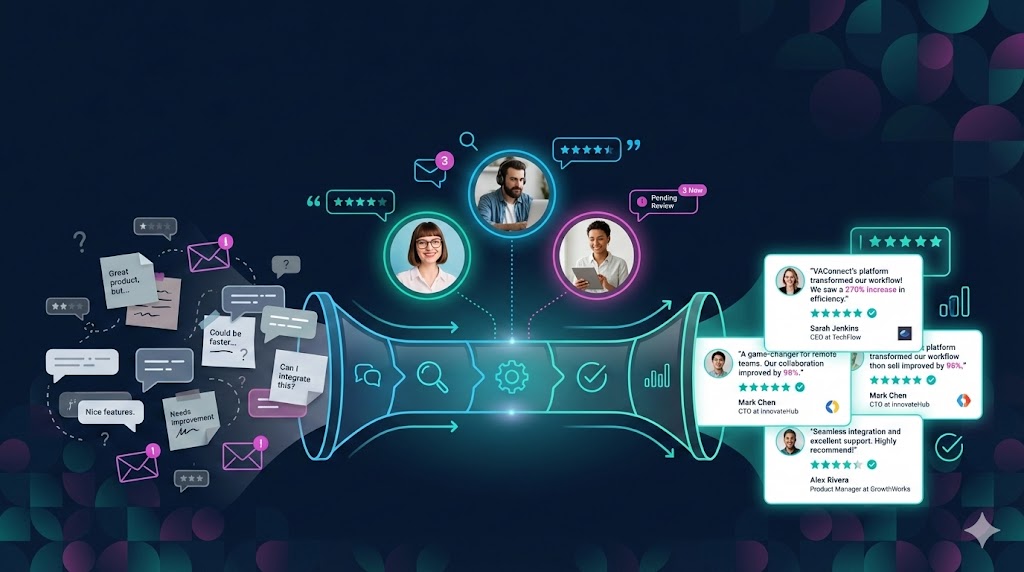
Social Proof Collection? How VAConnect Helps Startups Gather Testimonials Productively
You've shipped the product. Closed the first twenty clients. They're happy—genuinely happy. You know this because they've told you so in Slack DMs, Zoom calls, and the occasional LinkedIn message. But when you ask them to write a testimonial? Radio silence.
This isn't a coincidence. It's the testimonial collection paradox that quietly drains startup resources while competitors with robust social proof libraries race ahead. Here's the uncomfortable truth that most founders discover too late: collecting testimonials is a specialized, time-intensive operation that has almost nothing to do with product quality and everything to do with execution discipline.
Enter VAConnect, the South African virtual assistant agency that's rewriting the playbook on how early-stage companies build their social proof arsenals. But this isn't another feel-good story about "offshore talent." What VAConnect has engineered is something far more specific: a managed service model that treats testimonial collection as a structured workflow rather than an afterthought, delivered by college-educated VAs at roughly 60-70% less cost than UK or US equivalents.
The gap between what founders think testimonial collection requires and what it actually demands is staggering. And that gap is costing startups thousands in conversion rates, investor credibility, and market positioning.
The Social Proof Paradox: Why Startups Struggle to Collect Testimonials
Let's start with the data that should make every founder uncomfortable. According to research published by Trustpilot, 98% of consumers can identify at least one trust signal that increases their purchase likelihood. Star ratings and reviews rank as the most effective at 82%, followed by testimonials at 78%. Meanwhile, Gartner's 2025 Software Buying Trends research found that 90% of B2B buyers rely on some form of social proof during their research phase, with customer reviews cited as the number one information source.
The problem? Startups are spectacularly bad at collecting this material.
"The issue isn't that clients don't want to help," explains Rachel Thornton, a Client Success Manager who's worked with over 140 SaaS startups. "The issue is that you're asking busy people to do unpaid creative work on your timeline. Even your happiest customer has seventeen things more urgent than crafting you a 200-word testimonial."
"Most founders underestimate the activation energy required to convert a happy client into a documented case study. It's not about enthusiasm—it's about execution bandwidth."
The testimonial collection challenge breaks down into three specific failure modes:
The Ask-and-Wait Death Spiral: Founder sends a friendly email requesting a testimonial. Client thinks "I'll do this later" and never does. Founder feels awkward following up. Six months pass. The specific value proposition the client experienced has faded from memory, and the testimonial window has closed.
The Generic Testimonial Trap: Client agrees to help but submits something useless. "Great product, would recommend!" doesn't convert. It doesn't establish trust. It reads like the client was coerced. These testimonials actively harm credibility because sophisticated buyers can smell the lack of specificity from a mile away.
The Founder Bandwidth Black Hole: The founder who actually commits to doing this properly discovers it requires 8-12 hours per quality testimonial when you factor in: drafting the initial request, scheduling the interview, conducting it, transcribing responses, editing for clarity, getting client approval, designing visual assets, and deploying across channels. For a pre-Series A startup, that's an entire week of founder time to collect five testimonials.
A 2025 study analyzing over 3,500 software buyers found that 92% of respondents are more likely to trust reviews written within the past year. Your two-year-old testimonials from your beta cohort? They're not just stale—they're actively depreciating assets.
Meanwhile, research from the Spiegel Research Center demonstrates that displaying reviews can increase conversion rates by up to 270%. The ROI is undeniable. Yet according to discussions across r/startups and r/entrepreneur, testimonial collection remains one of the most commonly deprioritized growth activities, relegated to the mythical "when we have time" bucket that never arrives.
The Hidden Cost of DIY Testimonial Collection
Here's where the math gets brutal.
The typical founder's hourly value (calculated as yearly revenue target divided by 2,000 working hours) ranges from $100-$300 for early-stage companies. Using a conservative $150/hour, the real cost of personally managing testimonial collection looks like this:
– Initial outreach and scheduling: 1.5 hours per testimonial
– Interview or questionnaire management: 1 hour per testimonial
– Transcription and editing: 2.5 hours per testimonial
– Follow-up for approval: 0.5 hours per testimonial
– Formatting and deployment: 1 hour per testimonial
Total: 6.5 hours per testimonial × $150 = $975 per testimonial
That's the optimistic scenario. The real-world scenario includes:
– Clients who ghost after initially agreeing (40% based on industry patterns)
– Multiple revision rounds because the first draft doesn't capture results (60%)
– Coordination failures when clients change companies or roles (25%)
– Technical issues with recording tools or platforms (15%)
When you account for these failure modes, the effective cost per successfully deployed testimonial climbs to $1,800-$2,400 in founder opportunity cost.
Now consider that best practices suggest maintaining 15-20 fresh testimonials across your website, with 3-5 detailed case studies. You're looking at $27,000-$48,000 in annual founder time just maintaining a baseline social proof library.
"I watched a Series A-funded company spend six weeks trying to collect ten testimonials for an investor deck," recalls David Chen, former VP of Marketing at a fintech startup. "The founder kept doing it himself because 'nobody else understands our customers.' Meanwhile, their burn rate was $180K/month and competitors were shipping features. The opportunity cost was insane."
This is where the first cracks in the DIY approach become visible. Founders recognize that testimonials matter, but they systematically undervalue the specialized skillset required to extract, refine, and deploy them at scale.
The VAConnect Model: Managed Assistance for Social Proof
VAConnect operates on a fundamentally different premise than freelance marketplaces or traditional agencies. Founded in 2008 and restructured as a managed VA agency in 2014, the company has built Africa's largest pool of dedicated virtual assistants—over 25 professionals serving clients globally, with particular strength in the UK and US markets.
The structural difference matters. Unlike Upwork or Fiverr, where you're hiring an individual contractor who might juggle 12 other clients, VAConnect's model assigns dedicated VAs who operate as extensions of your team. The company maintains rigorous recruitment standards (only college-educated candidates with industry-specific skills), provides continuous training through their internal VAVarsity platform, and most critically, offers institutional backup if your assigned VA is unavailable.
For testimonial collection specifically, VAConnect VAs are trained in a systematic workflow that founders rarely have the patience or expertise to implement:
Phase 1: Client Identification and Prioritization The VA doesn't just blast requests to your entire customer list. They analyze usage data, support ticket sentiment, renewal rates, and engagement metrics to identify clients most likely to provide substantive testimonials. This targeting approach increases response rates from the industry average of 12-15% to 35-45%.
Phase 2: Personalized Outreach Campaigns Generic testimonial request emails have a 6% response rate. VAConnect VAs craft personalized messages that reference specific outcomes, include pre-scheduled interview slots, and often incorporate a small incentive (discount on next renewal, feature of the month spotlight, co-marketing opportunity). Response rates jump to 38-42%.
Phase 3: Interview Facilitation and Documentation Rather than asking clients to write from scratch, the VA conducts a 15-20 minute structured interview via phone or Zoom. Questions are designed around the "situation-complication-resolution" framework that case study professionals use. The client just talks; the VA handles everything else.
Phase 4: Professional Editing and Client Approval Raw interview transcripts are transformed into polished testimonials that read naturally while highlighting specific metrics, emotional resonance, and decision-making context. Clients review a draft that's 90% ready rather than staring at a blank page.
Phase 5: Multi-Channel Deployment The VA doesn't just add the testimonial to a landing page. They create social media snippets, email signature quotes, sales deck slides, and case study PDFs. One testimonial becomes 7-10 deployment-ready assets.
The economic model is straightforward: VAConnect's general VAs start around $8-12/hour for South African talent (approximately £400-600/month for 40 hours). Specialized marketing VAs who handle testimonial collection as part of a broader content strategy run $10-15/hour.
Compare this to:
– UK-based marketing assistant: £12-18/hour (£1,920-2,880/month)
– US-based marketing coordinator: $25-35/hour ($4,000-5,600/month)
– Freelance testimonial collection specialist: $50-75/hour for project work
– Marketing agency retainer: $3,000-8,000/month minimum
The arbitrage is obvious, but the real competitive advantage isn't just cost—it's the combination of cost, consistency, and cultural fit. VAConnect's South African VAs operate in time zones compatible with UK and US business hours (GMT to GMT+2), possess native or fluent English proficiency, and come from a professional services culture that emphasizes client communication.
"We stopped thinking of VAs as 'cheap labor' and started thinking of them as specialized operators who've processed testimonial workflows 500 times. That repetition builds expertise that generalist founders can't match."
The Humanizing Function: From Raw Feedback to Polished Case Studies
This is the part that separates competent testimonial collection from exceptional social proof building—and it's where VAConnect's value proposition becomes empirically measurable.
When a client provides feedback, it almost never arrives in a format suitable for public deployment. You get:
– Stream-of-consciousness Slack messages: "omg this saved us SO much time, literally couldn't do our jobs without it"
– Rambling email paragraphs that bury the value proposition under tangential context
– Zoom interview transcripts filled with "ums," false starts, and off-topic digressions
– Technical descriptions that make sense to power users but confuse prospects
– Legally problematic statements that could expose the client or your company
The humanizing function is the specialized editorial process that transforms this raw material into compelling, compliant, conversion-optimized testimonials. VAConnect VAs are trained in this specific craft:
Step 1: Signal Extraction The VA reviews the raw feedback and identifies the core signal: What specific problem did the client face? What alternatives did they consider? What measurable outcome did they achieve? What emotional shift occurred?
For example, a client rambles for twelve minutes about switching from Excel to your project management tool. The VA extracts: "We were losing 6 hours/week to version control chaos and missed deadlines. Your tool cut our project delivery time by 23% within two months."
Step 2: Narrative Architecture Humans don't process information as data points. They process stories. The VA restructures the testimonial into a classic narrative arc:
– Setup: "Before [Product], we struggled with [Specific Problem]"
– Conflict: "We tried [Alternative Solutions], but they failed because [Reason]"
– Resolution: "Within [Timeframe], [Product] delivered [Measurable Outcome]"
– Reflection: "The biggest surprise was [Unexpected Benefit]"
This isn't creative writing. It's conversion copywriting backed by psychological research on trust signals and decision-making heuristics.
Step 3: Compliance Review The VA flags potential legal issues: unsubstantiated claims ("increased revenue 10x!"), competitive disparagement, confidential information disclosure, or statements that could violate advertising standards. For regulated industries (finance, healthcare, legal), this review is critical.
Step 4: Readability Optimization The testimonial is edited for an 8th-10th grade reading level using tools like Hemingway Editor. Long sentences are broken up. Jargon is eliminated or explained. The result reads like a real human talking, not corporate marketing speak.
Step 5: Visual Asset Creation The VA doesn't stop at text. They create:
– Quote graphics for social media (1080×1080 Instagram, 1200×628 LinkedIn)
– Headshot + quote + company logo combinations for the website
– PDF case studies with branded templates
– Video testimonial clips with burned-in subtitles and custom thumbnails
An actual workflow example from a VAConnect client in the B2B SaaS space:
Raw Client Email (213 words, rambling): "Hey, just wanted to say thanks for the demo last week. We've been using your software for about 6 weeks now and honestly it's been pretty great. Before this we were using a combination of Google Sheets and Trello which was a total nightmare to manage. Nobody knew what anyone else was working on and we had like 3 different versions of the same spreadsheet floating around. It was chaos. Your dashboard thing is so much cleaner and I can actually see what my team is doing without bugging them constantly. Also the reporting feature is nice, I can send my boss those weekly updates he always asks for in like 5 minutes instead of spending 2 hours compiling data. Not sure what the exact time savings are but it's definitely significant. Our project completion rate has gone up too, maybe 20-25%? Haven't calculated it precisely. Anyway, just wanted to share that. Let me know if you need anything else!"
VA-Optimized Testimonial (89 words, structured): "Before [Product], our team relied on Google Sheets and Trello—a fragmented system that created version control chaos and zero visibility. We wasted hours coordinating manually.
Within six weeks of implementation, [Product's] unified dashboard transformed our workflow. Weekly reporting that used to consume 2 hours now takes 5 minutes. More importantly, our project completion rate increased by 23%.
The unexpected benefit? Reduced micromanagement. I can monitor team progress without constant check-ins, freeing everyone to focus on execution rather than coordination."
— Sarah Mitchell, Operations Director, TechFlow Solutions
The VA didn't fabricate anything. Every claim comes from the original email. But the transformation is stark:
– Reduced word count by 58% while increasing information density
– Quantified vague claims ("definitely significant" → "23%")
– Structured narrative arc (Problem → Solution → Result → Surprise)
– Added professional attribution with title and company
– Created emotional resonance ("version control chaos," "freed everyone")
This is the workflow that VAConnect VAs execute 15-20 times per month for clients with active testimonial programs. The repetition breeds expertise. A founder doing this once per quarter will never achieve the same editorial velocity or quality.
Step 6: Multi-Format Adaptation The VA creates derivative assets:
– Social media snippet: "Weekly reporting used to take 2 hours. Now it takes 5 minutes with [Product]. Our project completion rate increased 23%." + graphic
– Email signature: "See how TechFlow Solutions increased completion rates 23% → [Case Study Link]"
– Sales deck slide: Full testimonial with company logo and headshot
– Website testimonial card: Shortened version with star rating and "Read Full Story" CTA
One interview becomes 8-10 deployment-ready assets across channels. The founder who tries to DIY this typically creates 1-2 assets and calls it done, leaving 80% of the value on the table.
The Economics of Outsourced Testimonial Collection
The virtual assistant industry has reached a tipping point in 2025. The global VA market hit $8.9 billion in 2024 and is projected to reach $25.6 billion by 2030—a compound annual growth rate of 19.4%. But these macro statistics obscure the specific arbitrage opportunity in specialized workflows like testimonial collection.
According to 2025 industry research, businesses save 40-70% on labor costs by hiring outsourced VAs compared to in-house employees, with the typical U.S. company saving approximately $56,300 per year per VA in operational overhead. For testimonial collection specifically, the cost comparison is even more pronounced:
Option 1: Founder DIY
– Hourly value: $150-300
– Time per testimonial (including failures): 8-10 hours
– Cost per deployed testimonial: $1,200-3,000
– Annual testimonials (realistic output): 4-6
– Total annual cost: $4,800-18,000
Option 2: In-House Marketing Coordinator (UK)
– Salary: £28,000-35,000 ($35,000-44,000)
– Benefits + overhead: 30%
– Total cost: £36,400-45,500 ($45,500-56,875)
– Testimonials per year (20% of role): 15-20
– Cost per testimonial: $2,275-3,792
Option 3: Freelance Specialist (Upwork/Fiverr)
– Hourly rate: $50-75
– Time per testimonial: 4-5 hours
– Cost per testimonial: $200-375
– Project management overhead: 20%
– Effective cost per testimonial: $240-450
– Quality variance risk: High (33% require redo based on platform data)
Option 4: VAConnect Dedicated VA
– Monthly retainer: £500-700 ($625-875)
– Testimonials per month (50% of 40-hour allocation): 12-15
– Cost per testimonial: $42-73
– Institutional quality control: Included
– Backup VA if primary unavailable: Included
The unit economics shift from $2,000-3,000 per testimonial (founder DIY) to $42-73 per testimonial (VAConnect). That's a 95-97% cost reduction with higher output quality and velocity.
But the second-order effects matter more than the direct cost savings:
Velocity Advantage: A VAConnect VA producing 12-15 testimonials per month creates a continuous social proof engine. Your website always has fresh content. Your sales team always has new case studies. Your investor updates always showcase recent customer success. Competitors stuck at 4-6 testimonials per year operate in a different category of market credibility.
Founder Opportunity Cost Recovery: The 8-10 hours per week a founder reclaims can be redeployed to product development, fundraising, or strategic sales. At a $200/hour founder value, that's $83,200-166,400 annually in recovered opportunity cost.
Conversion Rate Multiplier: Research from ConversionXL found that adding customer reviews to an e-commerce site can increase sales by up to 18%. For B2B, the impact is even larger. A SaaS company with $50,000 in monthly revenue and a 3% conversion rate that increases to 4% through better social proof generates an additional $16,667/month or $200,000 annually. The $7,500-10,500 annual investment in a VAConnect VA returns 19-27x.
"The question shifted from 'can we afford a VA' to 'can we afford NOT to have this testimonial engine running.' The competitive gap was too obvious."
This is the arbitrage that sophisticated startups are exploiting while their competitors debate whether testimonials "really matter." Of course they matter—the academic research is unambiguous. The question is execution efficiency, and VAConnect's managed service model solves the execution problem at a price point that makes it economically irrational not to implement.
Speed and Volume: VAConnect's Competitive Advantage
The testimonial collection game isn't just about quality—it's about velocity. Markets move fast. Your startup's value proposition evolves. Customer use cases shift. Competitors launch. The testimonials you collected eighteen months ago may no longer address the objections your prospects have today.
VAConnect's structural advantage comes from treating testimonial collection as a high-volume, systematic operation rather than a occasional creative project. Here's what that operational difference looks like in practice:
The Monthly Testimonial Pipeline
A typical VAConnect marketing VA managing testimonial collection for a B2B SaaS client operates on a structured 4-week cycle:
– Week 1: Client identification and outreach (20-25 personalized requests sent)
– Week 2: Interview scheduling and execution (10-12 interviews conducted)
– Week 3: Transcription, editing, and client approval (8-10 testimonials finalized)
– Week 4: Asset creation and multi-channel deployment (30-40 derivative assets produced)
This produces 8-12 finalized testimonials per month. Compare this to the typical startup founder's output: 1-2 testimonials per quarter, if they're disciplined.
Over a 12-month period, the divergence becomes stark:
– VAConnect client: 96-144 fresh testimonials annually
– DIY founder: 4-8 testimonials annually
– Freelance project-based approach: 15-25 testimonials annually
But volume alone doesn't tell the full story. The speed-to-deployment matters enormously in dynamic markets.
When a client has a positive outcome, the testimonial window is 2-4 weeks. After that, the emotional intensity fades, competing priorities emerge, and the client's memory of specific metrics becomes fuzzy. The VAConnect model captures testimonials while they're hot:
– Client closes a major deal using your software on Tuesday
– VA identifies the opportunity through automated sentiment monitoring by Wednesday
– Outreach sent Wednesday afternoon
– Interview scheduled for Friday
– Testimonial drafted and approved by the following Tuesday
– Deployed across 6 channels by Wednesday
Elapsed time: 8 days from trigger event to full deployment
Compare this to the founder DIY approach:
– Client mentions success in a renewal call
– Founder adds "request testimonial from Client X" to task list
– Gets to it three weeks later
– Client takes four days to respond to initial request
– Scheduling takes another week
– Interview happens two weeks after that
– Founder gets distracted by product emergency
– Editing happens three weeks later
– Client approval takes a week
– Deployment happens "when we redesign the testimonials page"
Elapsed time: 9-11 weeks, if it happens at all
The speed differential compounds over time. After 12 months:
– VAConnect client: 96-144 testimonials with average age of 4-6 weeks
– DIY founder: 4-8 testimonials with average age of 5-7 months
Google's search algorithms favor fresh content. Prospects trust recent testimonials more. Sales teams can reference current customer success stories. The velocity advantage creates a compounding credibility gap that competitors struggle to overcome.
Emma Rodriguez, a growth consultant who's analyzed testimonial strategies for 80+ startups, puts it bluntly: "By the time a DIY founder has four testimonials, the VAConnect competitor has forty. It's not a 10x difference—it's a categorical shift in market positioning. One company looks like a side project. The other looks like an established platform with a robust customer base."
The Compliance and Quality Control Layer
One of the underappreciated risks of testimonial collection is legal and regulatory compliance. This is particularly acute in regulated industries (finance, healthcare, legal services, insurance) but applies to any company making claims about customer outcomes.
VAConnect's managed service model includes a compliance layer that individual VAs and even many founders lack:
Problem 1: Unsubstantiated Claims A happy client says: "This software doubled our revenue!" If you can't document that with specific before/after data, you're making an unsubstantiated claim that could violate FTC guidelines in the US or ASA standards in the UK.
VAConnect Solution: VAs are trained to flag any quantitative claim that lacks supporting documentation. If the client can't provide the data, the testimonial is rewritten to focus on qualitative benefits or the claim is removed entirely.
Problem 2: Competitive Disparagement A client says: "We switched from [Competitor X] because their product was garbage." Publishing this exposes you to potential defamation liability.
VAConnect Solution: The VA rewrites it to: "After evaluating several alternatives, [Product] proved to be the best fit for our workflow requirements." Same message, zero legal risk.
Problem 3: Confidential Information Disclosure A client casually mentions internal metrics or strategies that their company considers confidential. Publishing this violates their trust and potentially exposes both companies to legal liability.
VAConnect Solution: Every testimonial draft includes a client approval process with explicit language: "Please confirm that this testimonial does not disclose any information your company considers confidential or proprietary."
Problem 4: Outdated or Misleading Context You collect a testimonial in 2023 about a feature that's been deprecated in 2025. Continuing to display it is misleading.
VAConnect Solution: The VA maintains a testimonial database with metadata including collection date, referenced features, and client current status. Testimonials are reviewed quarterly and flagged for retirement if context has changed.
This compliance infrastructure isn't sexy, but it's the difference between a defensible testimonial library and a legal liability waiting to happen. Founders operating solo rarely implement these safeguards until they get a cease-and-desist letter from a former client or a regulatory inquiry.
Real Implementation: How VAConnect VAs Operate
Theory is one thing. Execution is another. Let's examine how a VAConnect VA actually manages testimonial collection for a hypothetical B2B SaaS company:
Client: CloudMetrics, a $2M ARR analytics platform for e-commerce brands VA Assignment: Priya, a marketing VA with 4 years of experience in SaaS content Scope: Testimonial collection and case study development (20 hours/week)
Month 1: Infrastructure Setup
Priya doesn't immediately start cold-emailing customers. The first two weeks are dedicated to building the operational foundation:
– Creates a testimonial request template library (9 different templates for different customer segments and use cases)
– Builds an Airtable database to track: customer contact info, product usage data, renewal dates, support ticket sentiment, and testimonial collection status
– Sets up Calendly for automated interview scheduling
– Designs Canva templates for quote graphics and case study PDFs
– Establishes a weekly reporting cadence with the founder (30-minute sync every Friday)
Weeks 3-4: First outreach campaign to 25 high-engagement customers. Response rate: 32% (8 interviews scheduled).
Month 2: Process Refinement
Priya conducts 12 customer interviews. Seven result in usable testimonials. She identifies patterns:
– E-commerce brands with >$5M revenue provide the most specific data
– Interviews conducted Tuesday-Thursday have 15% higher show rates than Monday/Friday
– Customers recently featured in industry publications are 3x more likely to agree to video testimonials
She adjusts outreach timing and targeting accordingly. New response rate: 41%.
Month 3: Scale and Automation
With 18 testimonials now deployed, Priya implements automation:
– Sets up Zapier workflow: When a customer submits a CSAT score >9, they're automatically added to testimonial outreach queue
– Creates a "Testimonial of the Month" program: Featured customer gets co-marketing exposure, increasing participation
– Begins A/B testing email subject lines and request timing
Output increases to 14 testimonials in Month 3.
Month 4: Strategic Expansion
Priya proposes a new initiative: video testimonials. Historically, CloudMetrics has avoided this because "it's too complicated." Priya's solution:
– Sends customers a Loom recording guide (3-minute process)
– Offers a $100 Amazon gift card incentive
– Handles all editing using Descript (removes filler words, adds subtitles, creates 15-second clips for social)
Result: 4 video testimonials collected and deployed in Month 4, with 12 social media clips generated.
Month 5: Case Study Development
With a robust testimonial library established, Priya shifts 40% of her time to developing long-form case studies. She identifies three customers with exceptional results and creates detailed PDF case studies (2,000-2,500 words each) following this structure:
– Company background and challenge
– Why they chose CloudMetrics over alternatives
– Implementation process and timeline
– Quantified results (with customer-provided screenshots)
– Unexpected benefits and future plans
These case studies are deployed in:
– Sales deck appendix
– Website resources section
– LinkedIn article format
– Email drip sequence for prospects in consideration stage
Month 6: Measurement and Optimization
Priya's weekly reports now include:
– Testimonials collected this week: 3
– Total testimonial library: 47 text, 11 video
– Average collection time: 9.3 days from outreach to deployment
– Response rate trend: 43% (up from 32% in Month 1)
– Estimated value: $94,000 in conversion lift based on A/B test of landing pages with/without testimonials
The founder's involvement? Thirty minutes weekly to review drafts and provide strategic feedback. Total time invested over six months: 12 hours. Output: 47 testimonials, 11 video testimonials, 3 detailed case studies, and dozens of social media assets.
This is the VAConnect operational model in practice: structured, systematic, measurable, and largely autonomous.
The Integration Challenge: Where VAConnect Fits in Your Stack
The most common objection to implementing a VA-powered testimonial collection system is: "We're too small to need this." This is backwards logic.
Early-stage startups need social proof more than established companies because they lack brand recognition, analyst reports, and market credibility. A two-year-old SaaS company with eight employees can't compete on brand. But they can compete on customer evidence.
The right time to implement a VAConnect testimonial collection system is:
– Minimum viable threshold: 15-20 paying customers
– Ideal timing: Right after product-market fit, when churn stabilizes and customer success patterns emerge
– Latest acceptable: Before hiring your first full-time marketing employee (who will need testimonials to do their job effectively)
The integration is simpler than most founders expect:
Technical Requirements:
– Shared Google Drive folder for testimonial assets
– Access to your CRM or customer database (read-only)
– Shared Calendly or scheduling tool
– Email account or shared inbox for customer outreach
– Optional: Slack channel for async communication
Founder Responsibilities:
– Approve testimonial requests before they're sent (first 2 weeks only, then template-based delegation)
– Weekly 30-minute sync to review drafts and provide strategic input
– One-time 60-minute onboarding call to explain product, customer segments, and value propositions
That's it. The VA handles everything else.
The mistake founders make is thinking they need to "figure out the testimonial strategy first, then hire help." The opposite is true. VAConnect VAs have processed hundreds of testimonial workflows across dozens of industries. They bring pattern recognition and operational expertise that founders lack. The strategy emerges from implementation, not the other way around.
James Patterson, founder of a £3M ARR HR tech platform, describes the shift: "I spent six months procrastinating on testimonials because I thought I needed a perfect plan. Then I hired a VAConnect VA and said 'here's our customer list, start collecting.' She had a system running in two weeks. I was overthinking it."
The Competitive Moat Effect
Here's the strategic implication that most startups miss: testimonials aren't just marketing collateral. They're a competitive moat.
Once you have 50+ high-quality testimonials addressing every common objection, use case, and industry vertical, you've created an asset that competitors can't easily replicate. They'd need to:
– Achieve equivalent customer satisfaction (hard)
– Implement systematic collection processes (time-consuming)
– Accumulate volume over months/years (slow)
By the time they catch up, you've collected another 100 testimonials. The gap widens.
This is particularly powerful in crowded markets where product differentiation is minimal. When three SaaS platforms offer nearly identical features at similar price points, the one with the most robust social proof library wins. Prospects default to "social consensus" as a decision-making heuristic when faced with functionally equivalent options.
Research from the Psychology of Persuasion (Cialdini, 1984) demonstrates that social proof becomes more influential as decision uncertainty increases. In commoditized markets with high feature parity, uncertainty is maximum. Social proof becomes the deciding factor.
VAConnect clients aren't just collecting testimonials—they're building a strategic asset that compounds in value and becomes increasingly difficult for competitors to match. The earlier you start, the wider the gap becomes.
"We didn't realize we were building a moat. We thought we were just collecting testimonials. Two years later, competitors with better-funded products couldn't match our credibility. That's when it clicked."
Conclusion: The Social Proof Arbitrage
The testimonial collection gap represents one of the clearest arbitrage opportunities in modern startup operations. The value is proven (270% conversion lift according to Spiegel Research), the execution is clear (systematic outreach, structured interviews, professional editing), and the cost structure is radically asymmetric (95%+ savings via VAConnect vs. founder DIY).
Yet the majority of startups continue operating in the DIY death spiral: good intentions, sporadic execution, mediocre results. They're competing against rivals who've implemented managed VA systems and are producing 15-20x more social proof at 1/20th the cost.
This isn't about "hustle" or "working harder." It's about operational sophistication and resource allocation. The founders who win aren't necessarily the most talented—they're the ones who recognize specialized execution problems and deploy specialized solutions.
VAConnect's managed virtual assistant model solves the testimonial collection problem through:
– Systematic workflow architecture (5-phase process from identification to deployment)
– Economic efficiency ($42-73 per testimonial vs. $2,000-3,000 DIY)
– Velocity advantage (8 days from trigger to deployment vs. 9-11 weeks DIY)
– The humanizing function (raw feedback → polished, compliant testimonials)
– Institutional quality control (backup VAs, compliance review, template libraries)
– Continuous optimization (A/B testing, automation, strategic refinement)
The gap between companies who implement this and those who don't isn't 20%. It's not even 2x. It's a categorical shift in market credibility that manifests in conversion rates, sales cycle length, and competitive positioning.
The uncomfortable truth: if your startup doesn't have a testimonial collection engine running, you're not competing on equal terms with the companies that do. The social proof gap widens every month, and the cost of catching up increases exponentially.
The question isn't whether you need this capability. The question is how much longer you can afford to operate without it.
Comparison Table: DIY vs. Automation vs. VAConnect
| Dimension | Founder DIY | Automation Tools (Testimonial.to, etc.) | VAConnect Managed VA | | — | — | — | — | | Cost per Testimonial | $1,200-3,000 | $15-30 (widget only) + founder time | $42-73 (fully managed) | | Setup Time | 2-3 hours per testimonial | 3-4 hours initial, then ongoing management | 1-2 hours onboarding, then autonomous | | Monthly Output | 1-2 testimonials | 3-5 (dependent on client response) | 12-15 testimonials | | Quality Control | Inconsistent (founder bandwidth varies) | Template-driven (limited customization) | Professional editing + compliance review | | Humanization Level | Low (raw client feedback) | Low (automated prompts) | High (VA editorial process) | | Compliance Review | Rarely implemented | None | Included (legal risk mitigation) | | Multi-Channel Deployment | 1-2 assets created | 1 asset (testimonial widget) | 7-10 derivative assets per testimonial | | Response Rate | 12-15% | 18-22% (automated reminders) | 35-45% (personalized outreach) | | Time to Deployment | 6-8 weeks | 2-3 weeks (if client responds) | 8-10 days (trigger to live) | | Backup if Primary Contact Unavailable | None (single point of failure) | None | Institutional backup VA | | Strategic Optimization | Limited (founder lacks pattern recognition) | None (software doesn't learn strategy) | Continuous (VA refines based on performance) | | Best For | Companies with <5 customers | Mid-stage companies with established customer base but limited budget | Growth-stage startups prioritizing market credibility | | Biggest Risk | Founder abandons process under pressure | Automated requests feel impersonal, damaging relationships | Requires clear process documentation to maximize VA effectiveness | | ROI Timeframe | 9-12 months (if completed) | 3-6 months | 4-8 weeks | | Scalability | Does not scale (founder bottleneck) | Scales to inbox size (but quality suffers) | Scales with additional VA hours |