It usually starts small. A founder books their own flights at 11pm because the travel site timed out earlier in the day. A managing director rewrites a sales follow-up for the third time because nobody else knows the client’s history. A marketing lead misses a content deadline, again, because the morning vanished into a calendar that someone forgot to defend. None of these moments feels like a crisis on its own. Strung together across a quarter, they become the quiet reason a business stops growing.
If you have ever ended a fourteen-hour day having done a great deal of work and almost none of it that actually moved the company forward, you already understand the problem this article is about. The fix is rarely “work harder.” It is usually “stop doing the work that someone else should be doing.” The hard part is knowing who that someone is, what exactly to hand them, and how to do it without creating a second job: managing the person you hired to give you your time back.
That last point is where most delegation goes to die. You find a freelancer on a marketplace, you spend two weeks briefing them, they vanish or underdeliver, and you quietly conclude that doing it yourself was easier. It wasn’t. You just hadn’t been given a structure that works.
This is a guide to the five service lines VAConnect runs, and to the logic underneath them. Not a brochure. A working map of which kind of support solves which kind of problem, so that by the end you can point at your own week and say, with some confidence, “that goes to an EVA, this goes to a marketing assistant, and that whole mess over there is a project manager’s job.” Because the company has operated since 2008 and delivered well over 250,000 hours of remote work, the model below is less a theory than a set of patterns observed thousands of times.
The goal of delegation is not to be busy together. It is to make yourself smaller in the parts of the business that don’t need you, so you can be bigger in the parts that do.
Why “Managed, Not Matched” Changes the Whole Equation
Before the five service lines make sense, one distinction has to land, because it shapes everything else: there is a difference between being matched with a person and being managed into a result.
The gig-platform model is a matching model. You post a role, you sift through profiles, you pick someone, and from that moment you are the employer, the trainer, the quality controller, the HR department, and the person who notices when something has quietly gone wrong. The platform took its cut at the introduction and has no further stake in whether the relationship works. If your assistant gets sick, takes a better offer, or simply ghosts, that is your problem to solve from scratch.
The managed model inverts this. VAConnect rebranded from its original consulting business, Lime Tree, into a managed virtual assistant company in 2014 precisely because the founder, Karen van Zyl, had watched the matching model fail clients over and over. Under the managed approach, the assistant is vetted, trained, supported, and overseen by the agency. If continuity is threatened, that is the agency’s problem to solve, not yours. Quality is monitored. Upskilling is continuous, through an in-house training portal the company calls VAVarsity. Wellbeing is actively managed through a programme called Atomic Energy, because a burned-out assistant is a liability dressed up as a saving.
This matters for the rest of this guide because every service line below inherits that managed layer. You are never just renting a pair of hands. You are plugging into a system that has a vested interest in the work coming back right.
Marketplaces sell you a transaction. A managed partner sells you an outcome — and stays on the hook for it.
There is hard evidence that the managed approach maps onto how remote work actually succeeds. A 2024 analysis by Great Place To Work, drawing on Trust Index survey data from 1.3 million employees, found that productivity ran nearly 42% higher at remote-friendly companies than at typical workplaces, and that the deciding factor was not location at all — it was cooperation, trust, and the systems that sustain them. <cite index=”9-1″>A multi-year study analyzing data from 1.3 million employees at certified companies found that organizations supporting remote or hybrid arrangements showed dramatically higher productivity.</cite> The same body of research notes that hybrid and remote arrangements cut attrition substantially, with one widely cited Stanford randomized trial finding remote workers roughly a third less likely to quit. <cite index=”9-1″>A randomized control trial found that employees working from home were just as productive as full-time office workers, equally likely to be promoted, and 33% less likely to quit.</cite>
Read that again through a delegation lens. Remote support works when it is built on trust and good systems, and it fails when it is left to chance. The managed model is, in effect, a machine for manufacturing that trust and those systems on your behalf. The matching model leaves you to build them alone, usually while running a company.
The Five Service Lines, in Plain Terms
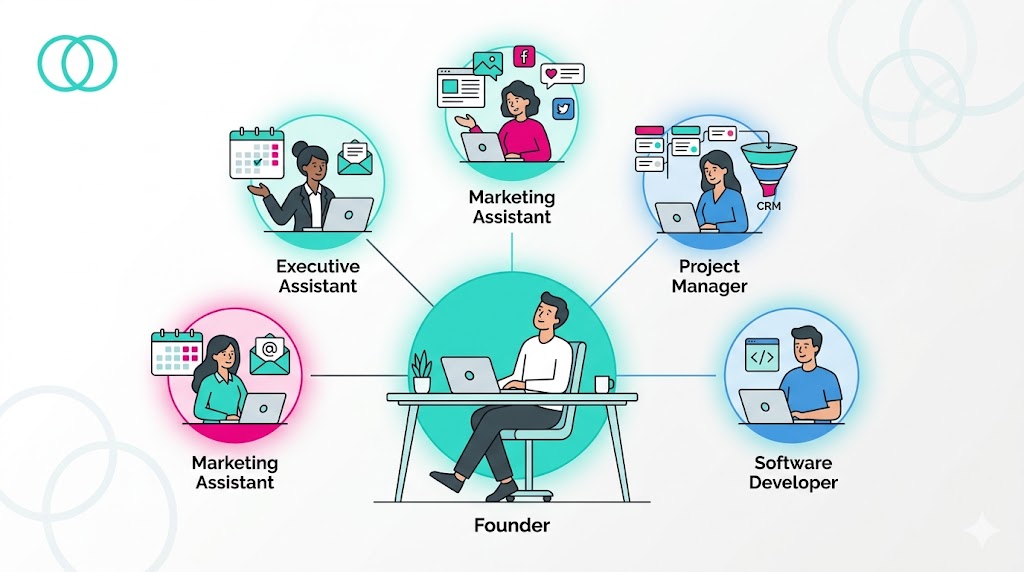
VAConnect organises its support around five distinct roles. People sometimes assume these are interchangeable — that a “virtual assistant” is one fungible thing. They are not. An executive assistant and a sales development rep are about as similar as a head chef and a sommelier: both essential, both in hospitality, completely different jobs.
Here is the short version, before we go deep on each:
- The Executive Virtual Assistant (EVA) protects your time and runs your operational life.
- The Marketing Virtual Assistant (MVA) builds and feeds your content and brand engine.
- The Sales Virtual Assistant (SVA / SDR) fills your pipeline and chases the revenue.
- The Project Manager (PM) keeps delivery on track across people and time zones.
- The Remote Software Developer builds and maintains the product or systems themselves.
The art is not in knowing the definitions. It is in matching them to the specific bottleneck that is currently strangling your week. Most founders need one of these acutely and one or two more once the first frees up enough capacity to notice the next problem.
1. The Executive Virtual Assistant: Buying Back Your Calendar
If you only ever delegate one thing, delegate the protection of your own time. The Executive Virtual Assistant exists for the person whose desk has become a runway with too many planes circling: meeting requests, a flooded inbox, travel that books itself badly, and a steady drip of small decisions that each take ninety seconds and collectively eat the day.
The work an EVA absorbs is deceptively heavy. Inbox triage, so that the twelve emails that actually need you surface and the eighty that don’t get handled or filed. Calendar defence, so that your deep-work blocks survive contact with other people’s urgency. Travel and logistics. Expense management. Meeting preparation, including the briefing notes that mean you walk in knowing exactly who you are talking to and why. At the senior end, an elite EVA stops looking like an assistant and starts looking like a chief of staff — the company internally refers to its top EVA tier as effectively merging into executive teams, sitting close enough to leadership to anticipate rather than react.
The reason this role returns so much value is rooted in a cost most leaders never put a number on: context switching. The research here is unambiguous and a little alarming. It takes an average of 23 minutes to fully regain focus after an interruption, and frequent context-switching can cut productivity by as much as 40%. <cite index=”24-1″>Frequent interruptions can cut productivity by up to 40%.</cite> <cite index=”27-1″>Research shows it takes an average of 23 minutes to regain focus after a distraction because different parts of your brain are activated every time you switch between tasks.</cite> Every time a founder drops out of strategic thinking to approve an invoice or reschedule a call, they pay that 23-minute tax. Across a day, the tax is the day.
Your brain needs roughly 23 minutes to refocus after each interruption. An EVA’s real job is to make sure those interruptions never reach you in the first place.
An EVA does not just do tasks. An EVA builds a wall between you and the flood, and then handles whatever is on the other side of it. That is why CEOs who hire one often describe getting back not just hours, but the kind of hours — the uninterrupted, high-altitude thinking time that had quietly disappeared.
2. The Marketing Virtual Assistant: Your Content Engine, Staffed
Marketing is the function founders most often “know they should do more of” and most consistently neglect, because it is rarely on fire. Sales is urgent. Operations are urgent. Marketing is important, which is a very different and much more easily postponed thing.
A Marketing Virtual Assistant turns marketing from a someday intention into a running system. The remit is broad by design: content scheduling and publishing, social media management, newsletter production, podcast and video support, design work, blog publishing, and the unglamorous but vital connective tissue of keeping a content calendar actually full. VAConnect describes its marketing team as a unified creative powerhouse rather than a single hire, which points at something important — modern marketing output is too varied for one generalist to cover well, and the managed-team structure lets specialised skills be drawn in as needed.
The strategic case for an MVA is simple. Content compounds. A blog post published today still earns traffic in eighteen months; a newsletter sent consistently builds an audience that a sporadic one never will. But compounding only works if the engine never stops, and founder-run marketing always stops, because the founder always has something more on fire. The MVA’s quiet superpower is consistency — the thing humans running their own companies are structurally bad at and a dedicated, managed assistant is structurally good at.
Tooling fluency matters here too. A good MVA arrives knowing the platforms — CRM systems, marketing automation, scheduling stacks — rather than needing to be taught them on your time. That is a direct benefit of the training layer; assistants are upskilled before they reach you, not during.
3. The Sales Virtual Assistant and SDR: Filling the Pipeline Without Adding Headcount
Great sales talent is hard to find. Managing sales professionals is harder. And for most growing businesses, the genuinely painful gap is not closing — founders are often decent closers — it is the grinding, repetitive top-of-funnel work that has to happen for there to be anything to close.
The Sales Virtual Assistant, often functioning as a sales development representative, owns exactly that grind. Lead research and list building. LinkedIn outreach. Appointment setting. CRM hygiene, so the pipeline reflects reality rather than wishful thinking. Follow-up sequences, which is where most deals actually die — not at the pitch but in the silence afterward that nobody had time to break. An SVA is an extension of your sales team that adds fuel to existing productivity, taking on either the whole funnel or just the parts that are leaking.
The economics are compelling because this is high-volume, process-driven work that does not require a senior, locally based, fully loaded salary to execute well. You are not hiring someone to redesign your sales strategy. You are hiring someone to relentlessly execute the parts of it that are tedious enough that you keep not doing them. That is the difference between a pipeline that grows while you sleep and one that grows only on the days you personally remember to feed it.
4. The Remote Project Manager: The Glue Across Time Zones
There is a specific failure mode that hits businesses right as they start to succeed. Suddenly there are multiple workstreams, several contributors, a couple of contractors, maybe a client or two with deliverables, and it is all being held together in the founder’s head and a slightly frantic group chat. Nothing is on fire, but everything is one forgotten handoff away from it.
This is the Remote Project Manager’s territory. As VAConnect puts it, the PM is the glue that keeps delivery on track. The role becomes essential precisely when coordination stops being trivial — when, in the company’s own framing, multiple distributed teams start working across different time zones and prioritisation gets genuinely hard. The PM collects and routes feedback, assigns and tracks work, manages dependencies, and makes sure the thing that needed three people to each do one part actually gets all three parts done in the right order.
The case for offloading this is partly about the founder’s bandwidth and partly about a cost almost nobody measures: coordination overhead. An Atlassian study of 5,000 knowledge workers found that nearly 78% struggle to get their work done because of how many meetings they attend, and that meeting-heavy days leave roughly 76% of workers drained. <cite index=”28-1″>Nearly 4 in 5 (78%) of respondents say they struggle to get their work done because of how many meetings they’re expected to attend each week, and 76% of workers said meeting-heavy days leave them totally drained.</cite> A great deal of that meeting load is coordination that a project manager is supposed to absorb — the status-chasing, the alignment, the “where are we on this” that metastasises into a standing 9am call when nobody owns it.
Most “we need a meeting about it” is really “nobody is managing this.” A project manager turns the meeting back into an email — or eliminates the need entirely.
A PM does not add to the coordination tax. A PM is how you stop paying it.
5. Remote Software Developers: Building, Not Just Buying
The fifth line is the one people are most surprised a virtual assistant company offers, and it reflects how the definition of remote talent has expanded. VAConnect provides remote software developers — engineers and coders who join as dedicated members of your development effort rather than as faceless gig contractors.
The pitch is geographic liberation. The company’s own framing is pointed: why limit your search for the best developers to your own postcode? Access to a far wider talent pool, combined with a vetting methodology designed to surface only strong engineers, lets a business scale its build capacity without the brutal cost and timeline of local technical hiring. For a product company, a SaaS startup, or any business whose growth is gated by engineering throughput, this is often the single highest-leverage line of the five.
What separates this from a freelance developer marketplace is, once again, the managed layer. The developer is vetted before you meet them, supported while they work with you, and continuously developed rather than left to stagnate. You get the flexibility of remote contracting with something closer to the stability of an in-house hire.
The South African Advantage: Why Geography Still Quietly Matters
Remote-work evangelists like to say location no longer matters. They are half right. Work can happen anywhere. Excellence still clusters — in ecosystems where talent depth, language, infrastructure, and cultural fit happen to line up. For businesses in the UK, Europe, and increasingly the US, South Africa is one of those clusters, and it is still underappreciated enough to be a genuine edge.
Start with the timezone, because it is the part people underestimate most. South Africa sits at GMT+2. That places it two hours ahead of London, one hour ahead of Frankfurt, and in the same working day as Dubai. <cite index=”12-1″>South Africa operates in GMT+2, which translates to seamless real-time collaboration with London (2-hour difference) and Frankfurt (1 hour).</cite> The practical effect is real-time collaboration rather than the relay-race frustration of working with assistants twelve hours out of sync. When a Manchester director sends a brief at 4pm, a Cape Town assistant can act on it the same afternoon, not the next morning. <cite index=”13-1″>The South African timezone (GMT+2) provides near-complete business-hour overlap with the UK and Western Europe — a strategic advantage that neither the Philippines nor India can match for European-focused operations.</cite> For US clients, the overlap is partial but workable, covering the morning hours where coordination matters most.
Then there is language. English is an official language in South Africa, spoken natively or near-natively by a large professional workforce, and — this part matters more than people admit — spoken with an accent widely rated as neutral and easy to understand. <cite index=”13-1″>South African English accents are widely considered neutral and easy to understand for both European and North American customers, making the country particularly strong for voice-based customer service and sales support.</cite> For roles involving direct client contact — an EVA fielding your calls, an SVA on outreach — that clarity is not a nicety. It is the difference between an assistant who represents your brand well and one who creates friction with every interaction.
The cost picture completes the case. Independent estimates put savings at 50–65% versus UK and European salaries for comparable knowledge work, with other analyses citing 40–70% against US-based equivalents. <cite index=”13-1″>Cost savings of 50–65% compared to UK and European salaries are achievable across most knowledge work roles.</cite> <cite index=”14-1″>Companies save roughly 40-70% on staffing costs by outsourcing to South Africa while maintaining exceptional quality.</cite>
A world-class professional, working in your business hours, in your language, at roughly half the cost of a local hire. The surprising part isn’t that the gap exists. It’s how few businesses have noticed it.
The critical caveat — and the reason cost should never be the headline reason you choose a partner — is that the savings only hold if the quality holds. The graveyard of outsourcing is full of relationships where the price was right and the output was wrong, where rework and miscommunication and management overhead quietly ate every rand that was supposed to have been saved. The managed model treats cost efficiency as a result of getting the work right, not as the goal. Which brings us to the part of this that no algorithm can do.
The Human in the Loop: Why a Managed VA Still Beats Pure Automation
It would be strange to write a guide to delegation in this decade without addressing the obvious question: why hire a person at all, when AI can draft the email, schedule the meeting, and summarise the call?
The honest answer is that AI is extraordinary at the tasks and surprisingly poor at the judgement. It can generate a follow-up message in seconds. It cannot tell that this particular client went quiet because of something said three calls ago, that the tone needs to be warmer than usual, and that the right move is actually to pick up the phone rather than send anything written at all. Automation handles the what. A skilled human handles the whether, the when, and the how it lands.
The research on remote work keeps pointing back to this same truth from a different angle. Across years of study, the factor that separates high-performing remote operations from struggling ones is not tooling or even location — it is trust, cooperation, and the human systems that produce them. The Great Place To Work analysis found that employees who feel they can count on others to cooperate are 8.2 times more likely to give extra effort. <cite index=”4-1″>Employees who feel they can count on others to cooperate are 8.2 times more likely to give extra effort.</cite> Discretionary effort — the going-beyond that no job description captures — is a fundamentally human contribution. It is the assistant who notices the thing you didn’t ask about and flags it, the one who remembers the client’s anniversary, the one who reads the room. No model does that because it isn’t doing a task; it is exercising care.
AI can write the message. It can’t notice that this is the wrong week to send it. The judgement of whether, not just the labour of what, is the human’s job — and it’s the job that actually protects your reputation.
This is also why the managed model and the human-in-the-loop principle reinforce each other. A managed assistant is supported, trained, and kept well — through continuous upskilling and active wellbeing programmes — precisely so that they have the headspace to exercise judgement rather than just grind through a queue. The smartest setup is not human or AI. It is a capable human using AI to clear the mechanical work fast, so that more of their day is spent on the judgement calls that move your business and protect your relationships. The tool amplifies the person. It does not replace them, and the businesses that bet otherwise tend to learn the difference the expensive way — usually through a customer who felt processed rather than served.
How to Choose: Matching the Line to Your Bottleneck
So which do you actually need? The honest method is not to study the five descriptions and pick the one that sounds nicest. It is to look at your last two weeks and find the bottleneck — the single category of work that, if it simply disappeared, would free you to do the things only you can do.
If your calendar and inbox own you, start with an EVA. If your marketing keeps stalling because you are the only one who ever touches it, start with an MVA. If your pipeline is thin because nobody is doing the unglamorous top-of-funnel grind, start with an SVA. If work keeps falling between people and time zones, you need a PM. If your growth is capped by how fast you can build, you need developers.
Most businesses begin with one, feel the relief, and then notice the next bottleneck that the first one was hiding. This is normal, and it is the logic behind building a small managed team rather than a single overloaded hire — a single point of contact coordinating several specialists, so that you brief once and the work distributes itself. Onboarding is deliberately light: a strategy-first conversation, a careful match on both skills and culture, then an introduction and a clear set of tasks and KPIs. The aim is to have you running in days, not weeks.
The Bottom Line: A System, Not a Hire
The thread running through all five service lines is the same one we started with. The point of delegation was never to be busy alongside someone else. It was to remove yourself from the work that doesn’t need you, reliably enough that you can trust it is handled and stop thinking about it.
That reliability is the whole game, and it is exactly what the matching model cannot promise and the managed model is built to deliver. The data on remote work is clear that it succeeds on trust and systems and fails on their absence; the gap between companies that have built those systems and those still trying to white-knuckle every task themselves has grown into something close to a chasm. A managed partner hands you the systems pre-built. The five service lines are simply the shapes that support takes once you decide to stop carrying everything alone.
The most useful reframe to leave with is this: your next hire should probably not be a person. It should be a system — a managed line of support, human at its core, that absorbs an entire category of your work and keeps absorbing it whether or not you remember to check. Pick the line that maps to your loudest bottleneck. Start there. Then watch how quickly the next one reveals itself.
| DIY Coordination | Generic Freelancers | VAConnect (Managed) | |
|---|---|---|---|
| Who manages quality | You | You | The agency |
| Continuity if someone leaves/is sick | N/A — it all stops with you | Your problem to re-solve from scratch | Covered by the managed model |
| Vetting & training | None | Self-reported, unverified | Pre-vetted; continuous upskilling via VAVarsity |
| Onboarding effort | N/A | High — you train from zero | Light — strategy-first match, running in days |
| Specialisation | One person (you) doing everything | One generalist | Five distinct service lines, drawn on as needed |
| Timezone alignment (UK/EU) | Yours | Random | GMT+2 — near-full UK/EU business-hour overlap |
| Cost vs. local in-house hire | Hidden cost: your own time | Cheap per hour, costly in rework | ~40–70% saving, quality held |
| Wellbeing & retention support | None | None | Active (Atomic Energy, VAPI) |
| What you’re really buying | Exhaustion | A transaction | An outcome — and a partner on the hook for it |
Ready to find which service line maps to your biggest bottleneck? Explore VAConnect’s services and book a strategy-first conversation to build your team, with our team.