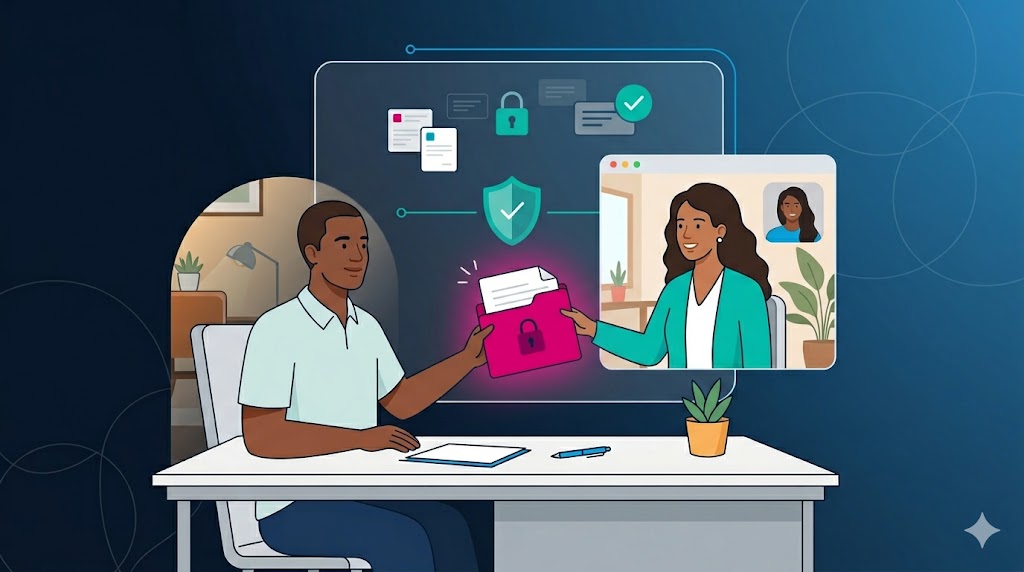
You hire a virtual assistant to take work off your plate. Within a fortnight they’re in your inbox, your CRM, your invoicing system, your client folders. They see customer ID numbers, banking details, medical records, signed contracts, the lot. It feels efficient. It feels like progress. And somewhere in that handover, almost nobody stops to ask the question that the Information Regulator will ask you later if something goes wrong: did you have a written agreement governing what that person could do with all that personal information?
That question is not academic. South Africa’s Protection of Personal Information Act has teeth now, and the people enforcing it have spent the last two years proving it. A R5 million fine here. A R500,000 fine there. Breach notifications climbing 40% year-on-year. The era where POPIA was a compliance poster on the wall and a checkbox in a board pack is over. If your business processes personal information — and almost every business does — then the moment you bring in outside help to handle that information, you’ve created a legal relationship the Act takes very seriously.
Here’s the part most owners miss: handing the work to someone else does not hand off the responsibility. Under POPIA, you stay on the hook. So the real question isn’t whether you can give a VA access to personal data. You can. The question is whether you’re doing it in a way that protects you, your clients, and the person doing the work. This guide walks through exactly that.
What POPIA Actually Is (And Why It Applies to You)
POPIA is South Africa’s data privacy law, and it governs how any “responsible party” — that’s you, the business deciding why and how personal information gets used — collects, stores, shares, and protects that information. Personal information is broad. It covers names, contact details, ID numbers, financial records, health data, employment history, even opinions about a person. If your business touches any of that, POPIA applies to you. There is no small-business exemption that lets you off the hook because you only have a handful of clients.
The Act lays out eight conditions for lawfully processing personal information, including accountability, security safeguards, and limits on what you can do with data once you have it. Of these, the security and accountability conditions are where most VA-related risk lives. You’re required to secure the integrity and confidentiality of personal information by taking reasonable technical and organisational measures to prevent loss, damage, unauthorised access, or unlawful processing. That obligation doesn’t pause when you delegate.
POPIA imposes statutory obligations on responsible parties only. Outsourcing or sub-contracting your processing activities does not absolve you from liability. If your operator contravenes the Act, you remain the one the Information Regulator holds accountable.
And enforcement is no longer theoretical. The Information Regulator held a media briefing in November 2025 outlining a string of penalties: R5 million fines against government departments, R500,000 against a municipality for exposing a former employee’s personal information, and R100,000 fines against private companies for failing to notify the Regulator of breaches and for ignoring enforcement notices. The Act allows the Regulator to issue administrative fines of up to R10 million, with serious offences carrying the possibility of imprisonment for up to ten years. On top of that, affected individuals can bring civil claims for damages. This is the environment your VA arrangement now lives in.
The “Operator” Relationship: The Legal Concept That Changes Everything
Here’s the piece of POPIA that turns a casual “can you help me with my admin” into a regulated relationship. The Act draws a line between two roles. You, the business, are the responsible party — you decide the purpose and means of processing personal information. Anyone who processes that information on your behalf, under your instruction, without coming under your direct authority, is an operator.
A virtual assistant handling your customer data is, in almost every case, an operator. Virtually every organisation makes use of an operator — a third-party vendor or service provider who processes personal information for them — and if a third party processes personal information for a responsible party, there are specific steps the law requires you to take. That’s not a grey area you can interpret your way out of. It’s a defined legal category, and it triggers defined legal obligations.
The most important of those obligations sits in Section 21 of the Act. Section 21 requires responsible parties to enter into a written operator agreement with operators regarding their processing of personal information. Not a verbal understanding. Not a line in an email. A written contract. And the contract has to do specific work: it must require the operator to establish and maintain the confidentiality and security measures needed to protect the integrity of the personal information, in line with Section 19 of POPIA.
What does that look like in practice? A solid operator contract establishes and maintains the security measures the Act requires; binds the operator to act only within the parameters of the agreement; limits them to handling only the personal information you’ve agreed on; and stops them sharing any of it with third parties. Section 20 adds that the operator must process personal information only with your knowledge or authorisation, and must treat it as confidential. In plain terms: the VA does what you’ve told them to do with the data, nothing more, and they keep it locked down.
This is precisely where so many DIY arrangements fall apart. When you hire a freelancer off a global marketplace and start forwarding them client spreadsheets, you’ve created an operator relationship in the eyes of the law — but you almost certainly haven’t created the operator agreement the law demands. The Information Regulator has already issued an enforcement notice against a company that, among other failings, had not entered into operator contracts, requiring it to put written agreements with all its operators in place within 31 days. The gap between “I’m just getting a bit of help” and “I’m now legally exposed” is one forwarded email wide.
The Liability Trap: Why “I Outsourced It” Is Not a Defence
Let’s be blunt about the thing that should keep you up at night. If your VA mishandles personal information — leaks it, loses it, sells it, leaves it sitting in an unsecured Dropbox — the Information Regulator does not knock on the VA’s door first. It knocks on yours.
The responsible party remains ultimately accountable for ensuring POPIA is complied with by both itself and every operator providing services to it. Where a breach occurs within the scope of the mandate between you and your operator, the Regulator will impose liability on you, the responsible party — it won’t be diverted to the operator simply because the operator was the one who failed. Read that twice. You can do everything right internally and still wear the consequences of your operator’s failure if you didn’t structure the relationship properly.
The single most expensive mistake in remote-help arrangements isn’t a data breach. It’s discovering, after the breach, that you carried all the liability and none of the protection — because nobody put the right agreement and the right safeguards in place before the work began.
A well-drafted operator agreement does two things at once. It satisfies your Section 21 obligation, and it gives you a contractual basis to recover from the operator if their negligence causes the harm. A sensible operator contract therefore includes a liability clause allowing the responsible party to bring a claim for any loss suffered as a result of the operator’s negligence or breach of POPIA. Without that contract, you’ve got the liability with no recourse. With it, you’ve at least built a backstop.
The risk is not hypothetical, and it’s not rare. SecurityScorecard’s 2025 analysis found that 35.5% of all breaches in 2024 were third-party related — a figure the researchers describe as likely conservative due to underreporting and misclassification. Nearly half of 2024’s data breaches were traced to vulnerabilities in third-party vendor access, including stolen credentials and excessive access rights, with overly permissive access a recurring theme — roughly 70% of those breaches involved excessively privileged vendor accounts. When you hand a stranger broad access to your systems with no governing framework, you’re not saving time. You’re statistically the likeliest point of failure in your own data chain.
The Five Things Your VA Arrangement Must Have
So what does compliant, sane delegation actually require? Strip away the legalese and it comes down to five things you need to have in place before a VA touches a single record.
First, a written operator agreement. This is non-negotiable under Section 21. It defines the personal information the VA may process, the purposes they may process it for, the security measures they must maintain, the prohibition on sharing data with anyone else, and what happens if any of that goes wrong.
Second, defined and limited access. The principle is least privilege: a VA gets access to exactly what they need to do the task, and nothing more. Given that overly permissive access drives a large share of vendor breaches, narrowing what your VA can reach is one of the highest-impact controls you can apply. If they’re managing your calendar, they don’t need your banking portal.
Third, breach notification discipline. An operator must maintain confidentiality and report any data breach to the responsible party without undue delay. Your arrangement needs a clear, fast line for the VA to flag anything that looks like a compromise, so you can meet your own notification duties to the Regulator and to affected individuals.
Fourth, training and awareness. POPIA compliance depends on staff awareness, and regular training — at induction and at least annually — should cover what personal information is, how to handle it, how to respond to a data subject request, and how to recognise and report a breach. A VA who doesn’t know what a data subject request is can’t help you answer one lawfully.
Fifth, ongoing oversight. Section 21 requires you to ensure your operators actually comply, which means regular review of operator agreements, security assessments, and evidence of compliance from the operator — not a one-time signature and then never again. Compliance is a relationship, not a document.
If reading that list made you realise your current freelancer arrangement has none of these, you’re not unusual. You’re typical. And that’s exactly the gap a managed model is built to close.
The Human in the Loop: Why a Managed Partner Beats a Tool or a Lone Freelancer
There’s a tempting line of thinking right now: why hire a person at all? Automate the admin, point an AI tool at the inbox, let software handle the data. No operator agreement, no human risk, problem solved.
It’s the wrong lesson. The data on where breaches actually come from points in a different direction. Around 60% of data breaches in 2025 involved a human element — malicious insiders, errors, or people falling for social engineering. The human element is the risk and the control. Software doesn’t notice that a “client” email asking for banking details has a subtly wrong domain. Automation doesn’t pause when a request feels off. A trained, accountable, supervised person does. The answer to human risk isn’t removing the human. It’s putting the right human in the loop, inside a structure that makes good behaviour the default.
That’s the difference between three models that look superficially similar. A lone freelancer from a global marketplace gives you a human, but no operator agreement, no security training, no oversight, and no recourse if they go rogue or simply get sloppy. Third-party contractors and vendors are implicated in a striking share of breaches precisely because “trusted partner” so often means “unmonitored partner” — even large vendors require oversight, and contractors need temporary, limited credentials rather than permanent broad access. A freelancer with the keys to your kingdom and no framework around them is the textbook risk profile.
A managed partner flips that. The agreement, the access controls, the training, the oversight, and the accountability aren’t things you have to remember to build — they’re built into how the relationship works from day one. The human is still there, doing the judgment-heavy work that software can’t. But that human sits inside a system designed to keep your data safe and your obligations met.
The future of safe delegation isn’t choosing between a person and a tool. It’s a trained human doing the judgment, supported by good process and real accountability — because the breach statistics make one thing clear: the danger was never the human. It was the human with no structure around them.
This is the reasoning behind VAConnect’s managed model. The company has been doing this since 2008, when it started as Lime Tree Consulting before rebranding to VAConnect as a managed virtual assistant business in 2014. Over 250,000 hours of work delivered, a team of 35-plus professionals, and — in the founder’s own scorekeeping — just two bad reviews across that history. That track record isn’t an accident of good luck. It’s what happens when the human in the loop is selected, trained, and supervised inside a deliberate structure rather than matched and forgotten.
The South African Advantage: Closer Than You Think, Safer Than You’d Expect
If you’re a South African business, there’s a quiet advantage to working with a South African managed partner that goes beyond convenience — it goes to compliance.
Start with the obvious: a VA in the same country operates under the same law. There’s no thicket of cross-border data transfer questions, no wondering whether the jurisdiction your freelancer sits in has any data protection regime at all, no awkward gap between the standard you’re held to and the standard your help is held to. POPIA applies to your operator the same way it applies to you. The compliance conversation happens in one language, under one Act, in one timezone.
That timezone point matters more than people expect. A South African VA works your hours, GMT+2, which means data handling happens during your business day, under live supervision, not overnight in a window you can’t see. Issues get flagged while you’re at your desk. Questions get answered in real time. The “without undue delay” breach notification standard is a lot easier to meet when your operator is awake and reachable when you are.
Then there’s the talent itself. South Africa offers university-educated professionals with native or near-native English, working in a business culture closely aligned with British and European norms — the kind of professionals who understand why a confidentiality obligation matters and how to honour it. You get genuine quality, not a cut corner. And the cost structure means you access that quality at a fraction of what an equivalent in-house hire would cost in the UK or Europe, without trading down on standards. Cost-efficiency and quality usually pull against each other. Here they don’t.
The combination — same legal framework, same working hours, high-calibre English-speaking professionals, real cost savings — is why so many South African owners stop trying to manage a patchwork of overseas freelancers and consolidate with a local managed partner instead. It’s not just easier. It’s safer.
How a Managed Model Bakes Compliance In From Day One
The practical worry for most owners is “this all sounds like a lot of work I don’t have time for.” It is — if you’re doing it alone, freelancer by freelancer, agreement by agreement. The point of a managed model is that the heavy lifting is already done.
When VAConnect places a professional with you, the relationship is structured rather than improvised. It begins with a “Strategy First” approach — a conversation about fit, needs, and how the work will actually flow — before anyone touches your systems. The professionals come through VAVarsity, the company’s continuous online training platform, so the person handling your data has been upskilled, not just hired. The published Non-Disclosure Policy, Data Protection page, and Privacy & GDPR documentation aren’t fine print bolted on afterward; they’re the standing framework the relationship operates inside. Accountability runs through the VAPI / Two-Way Happiness programme, which keeps both client and professional engaged and answerable rather than drifting.
Compare that to the alternative most people reach for first: find a freelancer, send them a spreadsheet, hope for the best. One of those approaches treats your personal information like the regulated asset POPIA says it is. The other treats it like a Tuesday afternoon convenience. The Information Regulator can tell the difference, and increasingly, so can your clients.
The managed model doesn’t make POPIA go away — nothing does, and you remain the responsible party no matter who you work with. What it does is make compliance the path of least resistance instead of a project you’ll get to eventually. The agreement exists. The training happened. The access is scoped. The oversight is ongoing. You get the help without manufacturing the exposure.
What This Means for Your Next Hire
POPIA didn’t make virtual assistants risky. It made unstructured delegation risky — and it put a price on getting it wrong that’s now measured in millions of rand and the possibility of personal liability for the people running the business.
The good news is that the fix is well understood and entirely achievable. You need a written operator agreement, scoped access, breach discipline, training, and oversight. You need a human in the loop, because the human is your best defence against the social-engineering and judgment-failure breaches that dominate the statistics — but a human held inside a real structure, not a freelancer with your passwords and no accountability. And if you’re a South African business, you have a genuine advantage in working with a South African managed partner that operates under the same law, in the same timezone, at a quality level that doesn’t force you to choose between compliant and affordable.
The businesses that figure this out aren’t the ones agonising over whether to delegate. They’re the ones delegating properly — and pulling away from competitors still treating their clients’ personal information like a problem for future them. The gap between those two groups is widening, and it’s widening fast.
If you want help that’s built to keep you on the right side of POPIA from the first day rather than the day after something goes wrong, that’s exactly what a managed model is for. Talk to VAConnect about how compliant, structured support actually works — and stop carrying risk you were never meant to carry alone.
At a Glance: Three Ways to Get Help, Three Very Different Risk Profiles
| Factor | DIY / In-House Coordination | Generic Freelancer (Marketplace) | VAConnect Managed VA |
|---|---|---|---|
| Written operator agreement (Section 21) | Often overlooked between internal teams; rarely formalised for casual help | Almost never in place; you’re exposed by default | Built into the engagement framework from day one |
| POPIA liability if data is mishandled | Falls entirely on you, with no recourse | Falls on you; little or no contractual recourse against the freelancer | You remain responsible party, but with a structured agreement and accountability backstop |
| Access control (least privilege) | Inconsistent; staff often over-permissioned | Typically broad, unmonitored access — a leading breach cause | Scoped to the task; access defined deliberately |
| Security training | Ad hoc, if any | None you can verify | Continuous via VAVarsity |
| Breach notification process | Usually undefined | Usually undefined | Clear escalation line to flag issues without delay |
| Ongoing compliance oversight | Rarely reviewed | None | Reviewed via managed model + VAPI accountability |
| Timezone / supervision | Live, but you carry the whole load | Often overnight, out of sight | GMT+2, working your hours under live supervision |
| Same legal jurisdiction as your business | Yes | Frequently no — cross-border data questions | Yes — SA-based, under POPIA |
| Recourse if negligence causes loss | None | Minimal | Contractual liability clause available |
| Net effect on your risk | High admin load, high exposure | Maximum exposure, minimum protection | Help delivered with compliance built in |
This article is general information about POPIA and outsourced data processing, not legal advice. For your specific obligations and operator agreements, consult a qualified data protection professional or attorney.