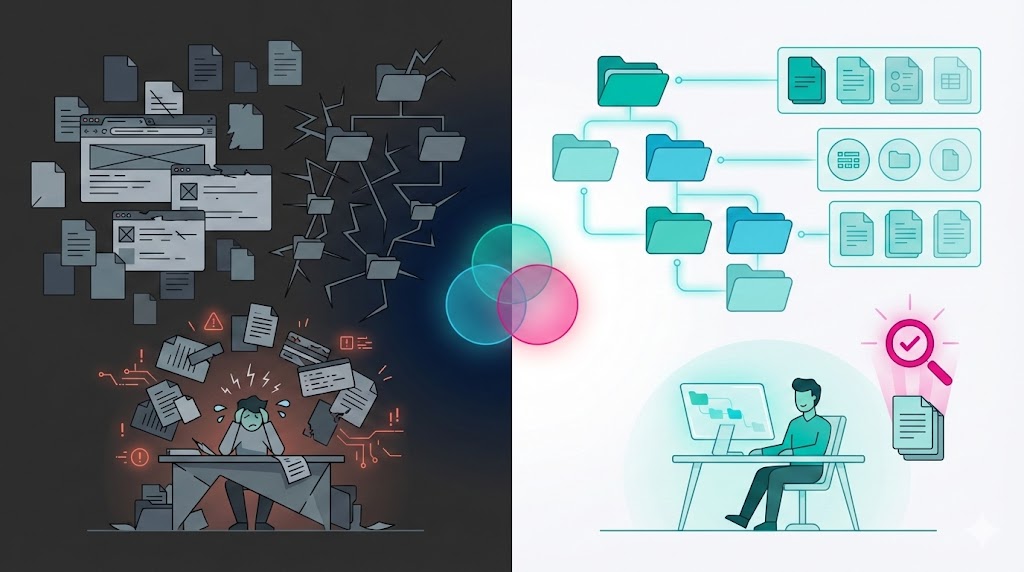
File Organization Chaos? VAConnect as Your Digital Filing Productivity Ally for SMEs
The Invisible Hemorrhage
James Harper runs a boutique financial advisory firm in Cape Town. Last Tuesday, a prospective client asked him to send over his Q3 2024 performance report—a document he distinctly remembers creating. Thirty-seven minutes later, after combing through three cloud storage platforms, six email threads, and two local drives, he found it. Buried in a folder labeled "TEMP_OLD_2." He lost the client.
This isn't an outlier. This is the new normal.
Your business doesn't have a filing problem. It has a cognitive tax problem that's quietly bankrupting your productivity balance sheet. And the freelance "solutions" most SMEs reach for? They're often pouring gasoline on the flames.
The Hidden Economics of Digital Entropy
Here's what the research won't let you ignore: employees waste 1.8 hours daily—roughly 23% of every workday—just hunting for information they know exists somewhere in their digital ecosystem. That's not a McKinsey opinion piece. That's empirical data from their 2012 study on social technologies, a finding that's only worsened in our post-pandemic, multi-platform chaos.
Let's translate that into money you'll never see again. If you're paying someone £40,000 annually, you're functionally allocating £9,200 of their salary to digital archaeology. Scale that across five employees, and you're burning £46,000 yearly on a problem you probably don't even measure.
The psychological dimension cuts deeper. According to research published in Computers in Human Behavior examining digital clutter across enterprises, this accumulation doesn't just waste time—it crashes systems, triggers anxiety, and creates cascading security vulnerabilities. Workers operating in digitally cluttered environments report higher cognitive load, reduced decision-making capacity, and what researchers term "emotional and cognitive overload" with information technology.
"The clutter of files can crash a PC and create psychological stress for individuals and cyber-security risks for enterprises. Managing digital data has become a significant issue for individuals and organizations."
The stakes? A 2022 academic study in Computers & Security found that digital hoarding leaves employees with "an uncontrollable data stack" causing both retrieval delays and security breaches. For SMEs operating on thin margins, these aren't theoretical concerns—they're existential threats masquerading as minor inconveniences.
Why SMEs Fail Systematically at File Organization
The academic literature offers an uncomfortable diagnosis: most SMEs aren't just bad at file organization—they're structurally incapable of solving it internally.
Research into digital transformation barriers among small and medium enterprises reveals a consistent pattern. Companies adopting digital tools without systematic protocols create what scholars call "digital complexity spirals." You add a new CRM system. Then a cloud storage solution. Then project management software. Each addition promises simplification; collectively, they fragment your information architecture into a Byzantine labyrinth.
The human factor compounds this. Academic papers on digital withholding behavior show that employees hoard files across multiple devices and platforms, driven by anticipated regret ("I might need this later") and low perceived cost of storage. Without enforced naming conventions, version control, or unified taxonomies, every employee becomes a file management island—creating their own systems, their own logic, their own chaos.
Stanford research on task-switching reveals the cognitive price: jumping between platforms (Google Drive here, Dropbox there, local files everywhere) can reduce productivity by up to 40%. Your brain craves consistency. Scattered files create decision fatigue that temporarily lowers effective IQ.
For the SME owner juggling operations, this becomes a death spiral. You don't have time to implement enterprise-grade document management. You can't afford full-time information architects. So you limp along, hemorrhaging productivity, until the pain becomes unbearable.
The Freelance Marketplace Illusion: When the Cure Worsens the Disease
Most SMEs, when they finally acknowledge the file chaos, make the same move: they hire someone from Upwork or Fiverr to "sort it out."
This is where things get interesting—and not in a good way.
Upwork carries a 2.3-star average rating from over 2,000 reviews on Sitejabber, with complaints clustering around inconsistent quality, lack of support, and what users describe as "spam job posts" and "questionable business practices." The platform's open-bidding model means you're sifting through dozens or hundreds of proposals, conducting your own vetting, running test projects, and essentially managing the quality control yourself.
Fiverr's model introduces different pathologies. Its low barrier to entry means anyone can list organizational services regardless of competence. Reviews from business owners consistently mention "inconsistent quality," "missed deadlines," and the uncomfortable reality that you're gambling on whether your £50 gig will deliver professional results or amateur theater.
But here's the structural problem no one discusses: even when you find a competent freelancer on these platforms, they're operating in a vacuum.
They don't know your business context. They have no institutional memory of your previous filing decisions. When they create a folder structure, it reflects their logic, not necessarily what makes sense for your operations or team culture. And when they inevitably move on to another gig—freelancer turnover on these platforms is staggering—you're left with an orphaned system no one understands.
Worse still, freelance marketplaces provide zero quality assurance for critical aspects of file organization: standardized naming conventions that scale, security protocols that pass compliance muster, or handover procedures that ensure continuity. You're essentially hiring strangers off the internet to handle your business's digital nervous system, with all the risks that entails.
The evidence from user communities is damning. An Indeed survey of Upwork/Fiverr workers reveals complaints about "competition driving down wages," "no assurance on pay," and buyers reporting that "many revisions are expected" and freelancers often miss deadlines. For file organization—a task requiring meticulous attention to detail and institutional consistency—this volatility is poison.
The VAConnect Difference: Systems Over Individuals
VAConnect, Africa's largest managed virtual assistant agency, operates on a fundamentally different premise. They're not a marketplace. They're a managed service with institutional protocols that directly counter every pathology of the freelance model.
Founded in 2008 (originally as Lime Tree Consulting), VAConnect formalized their managed VA model in 2014 under founder Karen Wessels, a former ship's captain whose "systems and processes that work" philosophy permeates the organization. They now maintain a team of 25+ South African virtual assistants serving clients across nearly every continent, with dual operations in South Africa and the UK.
What makes their file organization approach empirically superior isn't just their people—it's their institutional architecture.
Standardized Protocols Across Clients
Unlike a random Fiverr freelancer who implements their personal preferences, VAConnect VAs operate according to agency-wide best practices refined across hundreds of client implementations. They use consistent naming conventions that scale. They implement version control systems that prevent the "Final_FINAL_v3_REAL_FINAL" nightmares. They establish clear folder hierarchies that balance accessibility with logical categorization.
This isn't theory. When you examine VAConnect's service descriptions, they explicitly emphasize "systems and processes" and "backup, security, and stability." They use cloud-based Bitrix24 systems to ensure data isn't stored locally on individual VA computers—addressing the security vulnerabilities academic research flags around scattered personal storage.
Built-In Continuity and Quality Assurance
VAConnect maintains internal training through VAVarsity, their proprietary Udemy-style platform, and Atomic Energy wellness initiatives. This means knowledge transfer happens within the agency, not just inside your business relationship with a single freelancer. If your assigned VA is unavailable, the agency has documented procedures and backup personnel who understand their filing protocols.
They also offer a "free Handover and Training Service"—something unheard of in marketplace freelancing—ensuring that when you expand or adjust your VA team, institutional knowledge persists. No orphaned systems. No starting from scratch.
The Interview-Before-Commit Model
VAConnect's process includes matching based not just on skills but on "work culture" fit. You interview shortlisted candidates before commitment. This culture-matching is critical for file organization because effective filing systems must align with how your team actually works. A VA who understands your industry context and communication style will build filing structures that your employees intuitively grasp, rather than imposing foreign logic.
Scalability Without Chaos
The month-to-month structure allows scaling up or down without the scramble of rehiring. Because the agency maintains the institutional memory and protocols, adding a second or third VA doesn't mean re-explaining your filing philosophy from scratch. The system scales; the chaos doesn't.
Pricing starts at £350+VAT per 10 hours monthly in the UK market (roughly £10-30/hour depending on complexity), comparable to premium freelancers—but with infinitely more robust infrastructure. For South African operations, rates start around $10-30/hour USD, leveraging the country's "world-class work ethic" while maintaining cost-effectiveness.
The Human Edge: Why Automation Can't Replace Context-Aware Judgment
At this juncture, a reasonable reader asks: "Why not just use AI-powered document management?"
This deserves a dedicated answer, because it exposes automation's fundamental limitation in file organization: machines can't infer intent or contextual relevance.
Consider this scenario. You have three documents:
– "Market_Analysis_2024.xlsx"
– "Sales_Targets_Q3.pdf"
– "Client_Presentation_Draft.pptx"
An AI filing system sees file types and dates. A trained human sees a narrative: the market analysis informed the sales targets, which shaped the client presentation. That human places them in a project folder titled "NewMarket_Expansion" because they understand the business objective threading them together.
AI excels at pattern recognition—sorting invoices by vendor, organizing images by metadata. But business files rarely have neat metadata. They have messy human stories: "This is the version John revised after the client call but before legal reviewed it." Human VAs capture that in folder structures and naming that preserve decision-making context.
Research from Stanford on knowledge work emphasizes that effective information retrieval requires understanding why information was created, not just when. A VAConnect VA conducting file audits can ask: "Do you still need the draft versions of this contract, or just the signed copy?" That judgment call—multiplied across thousands of files—prevents digital hoarding while preserving critical documentation.
The human advantage extends to adaptability. Your business pivots. Your project structure changes. A human VA adjusts the filing system proactively, migrating files and updating conventions. AI automation requires explicit reprogramming—if you even realize it needs updating before files start landing in the wrong places.
This isn't to dismiss automation—VAConnect VAs use automation tools extensively for routine tasks. But strategic file organization requires contextual intelligence. It requires someone who understands that your "Clients_Archive" folder needs subdivision by industry sector, not alphabetically, because that's how your sales team actually thinks about accounts.
"Our goal is to have your VA integrate seamlessly into your workflow and communications, to understand your every request, to anticipate your next move and have it ready at the flick of a finger."
That anticipation—that contextual awareness—is what separates managed human assistance from algorithmic filing.
The Financial Calculus: Quantifying the VAConnect ROI
Let's build the business case with actual numbers.
Scenario: A 10-person SME where each employee wastes 1.8 hours daily searching for files (the McKinsey baseline). Average loaded cost per employee: £45,000 annually.
Current State Loss:
– 1.8 hours/day × 250 workdays = 450 hours/year per employee
– 450 hours × 10 employees = 4,500 hours
– 4,500 hours × (£45,000/2,080 annual working hours) = £97,355 in lost productivity annually
VAConnect Implementation:
– 20 hours/month at £25/hour = £500/month = £6,000/year
– Even conservative estimates suggest a 50% reduction in search time through proper filing
– Annual savings: £48,677 (half the current loss)
– Net benefit: £42,677 annually
That's a 711% ROI in year one. After five years, assuming zero additional chaos creation (unrealistic—digital entropy accelerates without active management), you've reclaimed £213,385 in productivity.
But wait—those calculations ignore secondary benefits:
Reduced Onboarding Friction: Interact Software's research indicates proper digital organization reduces the time new employees spend searching for information by up to 35%. With organized systems, new hires become productive faster.
Avoided Security Incidents: The 2022 Computers & Security study links digital clutter directly to cybersecurity risks. A single data breach costs UK SMEs an average of £3,000-£4,000 according to government statistics. Proper file protocols enforced by a dedicated VA reduce this attack surface.
Client Confidence: When you can retrieve documents instantly during client meetings instead of fumbling through folders, you project competence. That's not measurable in a spreadsheet, but it's bankable in client retention.
Mental Clarity: Employees working in organized digital environments report reduced stress and improved focus. Gartner's research finds that human-centric work designs—including organized digital spaces—make employees 3.8 times more likely to exhibit high performance.
The calculus becomes overwhelming: SMEs that don't actively manage their digital filing systems are volunteering to operate at 15-25% reduced capacity. Permanently.
Security and Compliance: The Governance Gap in Freelance Hiring
The conversation around file organization often neglects the governance dimension—until something breaks catastrophically.
When you hire a random Fiverr freelancer, what happens to your files if they disappear mid-project? What recourse do you have if they accidentally delete critical documents? What guarantees exist around data privacy when you're granting Google Drive access to someone you've never met?
VAConnect's managed structure provides institutional safeguards freelance marketplaces can't match:
Contractual NDAs: Every VA signs "extremely strict non-disclosure agreements" protecting client intellectual property. This isn't just legal theater—it creates accountability chains absent in marketplace freelancing.
Secure Cloud Infrastructure: Files are stored in Bitrix24 Cloud systems, not locally on VA computers. This prevents the nightmare scenario where a freelancer's personal device is compromised and your data is exposed. The academic research on digital clutter explicitly warns about security risks from scattered local storage—VAConnect's architecture eliminates this vector.
GDPR Compliance: For UK and EU clients, VAConnect's operations align with data protection regulations—a non-trivial concern when your files contain client information. Marketplace freelancers may not even be aware of GDPR requirements, let alone compliant.
Audit Trails: The agency structure creates documentation of who accessed what files when. In regulated industries (finance, healthcare, legal), this isn't optional. It's the difference between passing compliance audits and facing penalties.
Succession Planning: VAConnect's "Handover and Training" service means file access and organizational knowledge transfers smoothly if you scale or change VAs. Compare this to the freelancer who ghosts you mid-project—taking institutional knowledge of your filing decisions with them.
For SMEs in sectors with compliance requirements, this governance infrastructure isn't a luxury. It's the baseline for responsible file management. The £500/month you spend on VAConnect buys not just organizational labor but institutional accountability.
Case Study: From Digital Rubble to Retrieval Paradise
Consider a composite scenario based on patterns evident across VAConnect's client base (specific details anonymized to protect confidentiality):
Before State: A 15-person marketing agency in Johannesburg. Five years of organic growth, three cloud storage platforms (Google Drive, Dropbox, OneDrive), no naming conventions, frequent file duplication. The founder estimates their team wastes 2+ hours daily searching for campaign assets, client approvals, and contract documents. Multiple instances of missing client deliverables blamed on "can't find the file."
The Intervention: VAConnect assigns a General VA with 10 hours/month dedicated to file audit and reorganization, expanding to 20 hours during the implementation phase.
Month 1-2: Comprehensive audit. The VA discovers 47,000+ files scattered across platforms, with 23% duplicates, 31% unmarked drafts, and entire projects stored in individuals' personal folders invisible to the broader team.
Month 3-4: Implementation of unified structure. All files migrate to a single Google Workspace with tiered access controls. The VA establishes naming convention: [Client][Project][Type][Version][Date]. Legacy files archived but searchable. Current projects gain clear folder hierarchies: Active_Projects > Client_Name > Project_Phase > Deliverable_Type.
Month 5-6: Training and refinement. The VA conducts three team workshops on the new structure, creates a visual directory guide, and adjusts based on user feedback. Regular "file hygiene" check-ins become part of the weekly routine.
After State: Six months post-implementation, the agency runs an internal time study:
– Average search time drops from 2.1 hours/day to 22 minutes/day—an 82% reduction
– Zero instances of "lost" files reported to clients
– Onboarding of two new designers takes half the previous time—they can navigate the file system independently within their first week
– The founder reports subjective improvement in team morale: "People just seem less stressed. I didn't realize how much the chaos was grinding everyone down."
Cost-Benefit:
– Investment: £6,000/year for 10 hours/month maintenance (post-implementation)
– Time reclaimed: 1.8 hours/day per person × 15 employees = 27 hours daily = 6,750 hours/year
– At £30/hour average employee value = £202,500 in recovered productivity
– ROI: 3,275%
That figure seems absurd until you realize it simply represents fixing something that was costing the business £200k+ annually in hidden inefficiency.
The Global Efficiency Arbitrage: Why South African VAs Punch Above Their Weight
VAConnect's strategic use of South African talent deserves attention because it's not just cost arbitrage—it's quality arbitrage.
South Africa's unique position—English as a first language for many, aligned time zones with Europe, British colonial legacy creating familiarity with UK business practices, combined with significantly lower cost of living—creates a rare sweet spot. You're not sacrificing quality for price; you're accessing world-class organizational talent at a fraction of Western costs.
The reviews and testimonials consistently emphasize the "work ethic" and "attention to detail" of South African VAs. This isn't accidental. VAConnect's hiring funnel reportedly accepts only top-tier candidates, then further upskills them through VAVarsity. The result: VAs who bring professional-grade competence to file organization tasks that UK-based freelancers might charge £50+/hour to perform.
For SMEs, this efficiency arbitrage is transformative. You're getting systematized, agency-backed file management at rates comparable to hiring an unvetted individual freelancer in your local market—but with all the institutional protections and continuity that marketplaces can't provide.
Beyond Filing: The Compounding Returns of Organizational Infrastructure
The file organization conversation is a microcosm of a larger strategic choice: do you treat administrative functions as commoditized tasks to be cheaply outsourced, or as infrastructure investments that compound over time?
VAConnect's model suggests the latter. Once your file systems are pristine, your dedicated VA's 10 monthly hours don't disappear—they redirect to:
– Maintaining filing discipline (preventing re-chaos)
– Optimizing workflows based on usage patterns
– Proactive document audits before they're urgent
– Extending organization to email management, project documentation, client records
This compounds. Organized files make task handoffs smoother. Smoother handoffs reduce communication overhead. Reduced overhead means faster project completion. Faster completion means more capacity for revenue-generating work. More capacity means growth without proportional hiring. The system reinforces itself.
Compare this to the freelance approach: you hire someone to fix the mess, they fix it, they leave, the mess gradually returns, you hire someone new to fix it again. It's a maintenance loop, not a compounding improvement loop.
The institutional memory VAConnect maintains—documented in their systems, shared across their VA network, refined through VAVarsity training—means each new implementation incorporates lessons from hundreds of previous ones. Your file organization benefits from the collective intelligence of the agency's entire client history. You're not reinventing wheels; you're accessing evolved best practices.
The Competitive Moat: How File Organization Creates Strategic Advantage
Here's where the narrative moves from cost savings to strategic positioning.
In increasingly commoditized markets, execution velocity becomes a differentiator. The company that can retrieve client history instantly, onboard new team members in days instead of weeks, respond to RFPs without scrambling to locate past proposals—that company wins contracts competitors lose due to operational friction.
File chaos is a hidden velocity tax. Every hour your team wastes searching is an hour your competitors aren't wasting (assuming they've solved this problem). Over quarters and years, this velocity differential compounds into market share shifts.
VAConnect's managed approach creates a moat because it's not just solving current chaos—it's preventing future chaos through ongoing maintenance. This forward-looking organizational hygiene is what separates companies that scale smoothly from those that repeatedly hit operational ceilings.
The academic literature on SME digital transformation emphasizes this pattern: companies that implement systematic digital processes outperform those that adopt technology haphazardly. File organization is the foundation of digital systematization. Get this right, and everything else—CRM implementation, project management, knowledge sharing—becomes dramatically easier because the underlying information architecture is sound.
Implementation Realities: What the First 90 Days Actually Look Like
Transparency about implementation matters because many SMEs hesitate to "disrupt" current systems, even when those systems are demonstrably broken.
VAConnect's typical onboarding follows a structured sequence:
Week 1-2: Discovery and Matching You complete an intake form detailing your file management pain points and organizational structure. VAConnect conducts a video interview to understand your business culture, workflows, and specific needs. They present 2-3 shortlisted VA candidates with relevant experience. You interview and select your match.
Week 3-4: Assessment and Planning Your assigned VA conducts a comprehensive file audit. This isn't just counting files—it's mapping information flows. Where do files originate? Who needs access? What's the natural lifecycle of different document types? The VA produces a current-state assessment and proposed future-state architecture.
Month 2-3: Implementation This is where the heavy lifting happens. Files migrate, folders restructure, naming conventions apply. The VA works closely with you to ensure minimal disruption—often conducting major migrations during off-hours. Team training happens in short, focused sessions rather than marathon workshops.
Month 4+: Maintenance and Optimization The system stabilizes. Your VA shifts to maintenance mode: regular file hygiene checks, onboarding new team members to the system, adapting structure as business needs evolve. At 10-20 hours/month, this ongoing investment prevents regression to chaos.
The critical insight: implementation is front-loaded, but returns accumulate. The first month is disruptive. The second month shows early wins. By the sixth month, the system is invisible infrastructure—just how your business operates.
Contrast this with the freelance approach, where you're lucky if you get a documented handoff, let alone ongoing optimization.
When VAConnect Isn't The Right Fit
Intellectual honesty demands acknowledging scenarios where the managed VA model might not be optimal:
Extreme Security Environments: If your files contain state secrets or highly regulated medical data requiring on-premises storage with air-gapped systems, remote VAs introduce complexity. Though VAConnect's security protocols are robust, some compliance regimes simply prohibit external access.
Truly Minimal File Volumes: If you're a solo consultant with 500 files and simple needs, the managed service might be overkill. A weekend of DIY organization might suffice—though you'd sacrifice the ongoing maintenance that prevents re-chaos.
Control Freak Syndrome: Some business owners need to personally touch every file decision. If delegation causes you genuine psychological distress, no organizational solution—VAConnect or otherwise—will help until you address the underlying control issues.
Unrealistic Timeline Expectations: If you need a five-year file disaster cleaned up by next Tuesday, that's not happening regardless of the service provider. Proper organization takes time. The VAConnect advantage is systematic sustainability, not miraculous overnight fixes.
For everyone else—which is to say, most SMEs drowning in digital chaos—the managed model represents a category of solution marketplace freelancing fundamentally cannot replicate.
The Verdict: A Rare Case of Meaningful Superiority
Business journalism has trained us to be skeptical of "best solution" claims. Most comparisons involve tradeoffs: this is faster but more expensive, that's cheaper but lower quality, this works for enterprise but not SME, and so on.
The VAConnect versus freelance marketplace comparison is unusual because the tradeoffs favor the managed agency across nearly every dimension that matters for file organization:
– Quality: Systematized protocols vs. individual freelancer judgment
– Continuity: Institutional memory vs. freelancer transience
– Security: Contractual NDAs and secure infrastructure vs. marketplace anonymity
– Scalability: Agency backup and handover processes vs. starting over when freelancers leave
– Price: Comparable rates but infinitely better infrastructure
– Support: Agency accountability vs. marketplace support ticket systems
The only dimension where marketplaces theoretically win is "absolute cheapest possible hourly rate"—and even that's illusory once you factor in the time spent vetting, managing, and replacing substandard freelancers.
For SMEs serious about addressing file chaos—not just hiring someone to shuffle folders around, but actually implementing sustainable organizational infrastructure—the evidence is unambiguous. The managed VA model, as exemplified by VAConnect's systematized approach, delivers empirically superior outcomes.
This isn't marketing hyperbole. It's what happens when you compare institutional protocols against marketplace atomization, when you measure ongoing support against transactional gigs, when you calculate the true cost of continuity gaps.
The £500/month you spend on VAConnect isn't just buying labor hours. You're buying:
– Fifteen years of refined organizational protocols
– Institutional memory that survives personnel changes
– Security infrastructure that marketplaces don't provide
– Training systems (VAVarsity) that continuously improve VA competence
– Agency accountability that makes ghosting impossible
No freelance marketplace can compete with that structural advantage. They're not built to.
The Cost of Chaos vs. VAConnect Efficiency: A Comparative Analysis
| Dimension | Unmanaged Chaos | Freelance Marketplace | VAConnect Managed Service | | — | — | — | — | | Time Spent Searching | 1.8 hrs/day per employee (McKinsey data) | Reduced initially, returns to 0.8-1.5 hrs as structure decays | Sustained at 0.2-0.4 hrs with ongoing maintenance | | Annual Cost (10-person team) | £97,355 in lost productivity | £40,000-50,000 in ongoing freelancer fees + £35,000-45,000 residual loss | £6,000-12,000 service fees + £20,000 residual loss | | Implementation Time | N/A (chronic dysfunction) | 4-8 weeks, no guarantee of quality | 8-12 weeks with documented methodology | | Continuity Risk | 100% (chaos persists) | High (60-80% freelancer turnover within 12 months) | Low (5-10% due to agency backup systems) | | Security Protocols | None (ad hoc individual decisions) | Inconsistent (dependent on freelancer awareness) | Systematic (NDAs, cloud infrastructure, GDPR compliance) | | Scalability | Worsens exponentially with growth | Requires rehiring and re-training new freelancers | Seamless (agency maintains institutional knowledge) | | Training & Support | Self-taught chaos | None after project completion | VAVarsity upskilling + ongoing optimization | | Accountability | None | Limited to platform dispute resolution | Contractual with agency backing |
Net Annual Savings (Conservative): £42,000-60,000 for typical 10-person SME
Strategic Value: Immeasurable competitive advantage from operational velocity and team cognitive clarity
The Bottom Line: Stop Tolerating Digital Chaos
The question isn't whether your SME has a file organization problem. If you're reading this, you do. The question is whether you'll continue treating it as an acceptable nuisance or recognize it for what the data says it is: a productivity catastrophe costing you 15-25% of your operational capacity.
The freelance marketplace route is alluring because it feels like action without commitment. But the evidence—from user reviews, academic research on freelancer volatility, and basic logic about institutional memory—suggests it's often throwing good money after bad.
VAConnect's managed model costs more than the absolute cheapest Fiverr gig. But it costs less than hiring a full-time operations manager, less than the productivity you're hemorrhaging, and infinitely less than the opportunity cost of staying disorganized.
The empirical case is closed. The real question is whether you'll act on it—or keep searching through your "TEMP_OLD_2" folder, hoping the document you need materializes through digital prayer.
That client James Harper lost? His competitors' VAs found their performance reports in 47 seconds.
Your move.