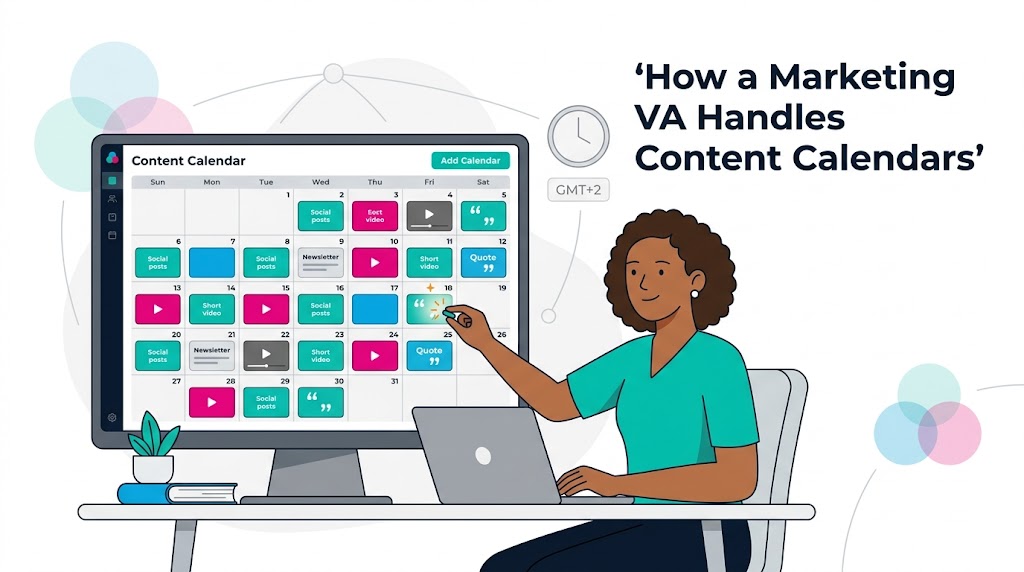
There is a particular kind of dread that visits founders on a Sunday night. The week ahead is already crowded with sales calls, a product fix, two client fires, and a payroll run. And somewhere underneath all of that sits the nagging reminder that the company’s Instagram hasn’t been touched in eleven days, the newsletter is three weeks overdue, and the LinkedIn page still has a post from a campaign that ended last quarter pinned to the top.
You know it matters. You also know you won’t get to it. So you do what most owners do: you fire off two rushed posts on Monday morning between meetings, feel briefly relieved, then watch the gap widen again until the next wave of guilt arrives.
This is the quiet failure mode of content marketing for busy businesses. Not a lack of ideas. Not a lack of effort. A lack of a system, and a person who owns it. The content calendar is supposed to be that system. In practice, for most small teams, it’s a half-filled spreadsheet that everyone has access to and no one maintains.
A marketing virtual assistant changes that equation. Not by adding another tool, but by becoming the single person whose actual job is to make sure the right thing goes out on the right channel on the right day, in your voice, without you having to think about it. Here’s how that works in practice, and why the way you hire that person matters more than most businesses realise.
The Real Cost of an Empty Calendar
Let’s start with why this is worth solving at all, because the stakes are easy to underestimate.
The data on consistency is unambiguous. Companies that publish 16 or more posts a month generate around 3.5 times more traffic and 4.5 times more leads than those publishing only zero to four. The platforms themselves are built to reward rhythm: posting often doesn’t automatically lift engagement, but a steady cadence builds the momentum that algorithms reward over time. Show up erratically and you don’t just lose ground, you actively train the algorithm to ignore you.
A steady, reliable presence beats viral content. The brands that win aren’t the loudest in the room — they’re the ones whose audience knows exactly when to expect them.
The problem is that “steady” is precisely the thing a stretched founder cannot deliver alone. An Adobe survey of business owners found the picture starkly: 44% of owners post only once a week, 44% feel pressure to post more often, and nearly half — 48% — said watching other brands’ activity made them feel they weren’t posting enough. The emotional toll is real, too. Among business owners using TikTok professionally, 88% reported posting burnout and 81% felt pressure to post daily. This is not a discipline problem. It’s a capacity problem dressed up as a discipline problem.
And there’s a second, subtler cost that almost no one accounts for: what content work does to the rest of your day. Marketing is a context-switching machine. You draft a caption, then jump to a sales email, then back to find the image, then off to approve an invoice. Each of those switches carries a tax. Research from the University of California found it takes an average of 23 minutes and 15 seconds to fully regain focus after an interruption. The reason is something psychologists call attention residue. Sophie Leroy of the University of Minnesota identified the phenomenon — leftover thoughts from a previous task that keep competing for mental bandwidth when you try to start the next one.
So when a founder squeezes “do the social media” into the cracks of a packed day, the true cost isn’t the twenty minutes of posting. It’s the fractured concentration on everything around it. Chronic context switching can consume up to 40% of a person’s productive time — which means an eight-hour day can quietly collapse into under five hours of real output. The empty calendar isn’t just hurting your reach. It’s hurting your focus on the work only you can do.
What a Content Calendar Actually Is (and Isn’t)
Before we talk about who runs it, it’s worth being precise about what a content calendar is, because the word gets thrown around loosely.
A content calendar is not a posting schedule. A posting schedule is a list of times. A content calendar is the operating system for your brand’s published voice. At its best it answers, well in advance, a set of questions that most businesses only answer in a panic: What are we saying this month, and why? Which channel carries which message? What’s the mix between evergreen value, timely commentary, and promotion? Who’s drafting it, who’s approving it, and when does it go live? What did last month’s numbers tell us to do more or less of?
When that’s documented and maintained, the benefits compound. A well-kept calendar delivers consistent branding through a unified voice and schedule, a stronger content mix of evergreen, seasonal and engagement posts, cleaner approval workflows, and the ability to track metrics and refine — all while reducing the daily stress of figuring out what to post. It removes the blank-cursor problem. When you follow a publishing calendar, it minimises the creative struggle of figuring out what to create — you just follow the schedule and share.
The catch is in the word “maintained.” A calendar is only as good as the person tending it. An untended calendar is worse than none, because it creates the illusion of a system while quietly rotting. This is the gap a marketing VA fills — not the document, the ownership.
The Workflow: How a Marketing VA Runs Your Calendar Week to Week
Here is what it actually looks like when a trained marketing VA takes the calendar off your plate. The point is not that these are magic tasks — it’s that they happen reliably, every cycle, without you initiating them.
Planning the month before it starts. A good VA doesn’t wait for instructions. Towards the end of each month they build out the next month’s grid: key dates, product launches, seasonal hooks relevant to your industry, recurring series. They bring you a draft to react to rather than a blank page to fill. You spend fifteen minutes steering instead of three hours building.
Batching the creation. Instead of producing content one anxious post at a time, the VA batches. Batch content creation — planning ahead — is what lets a business keep posting even when life gets busy, and it’s reinforced by repurposing each idea into multiple pieces. A single webinar becomes a LinkedIn post, three short clips, a newsletter section, and two quote graphics. The calendar makes that repurposing visible and deliberate rather than accidental.
Tailoring to each channel’s rhythm. Posting frequency isn’t one number. The data shows posting consistently between three and five times per week on major platforms is the most reliable benchmark for growth, and businesses that hold that rhythm see stronger engagement and steadier results than those who post sporadically. But the platforms differ. On LinkedIn, posting more often signals to the system that the account is active and trustworthy, which widens the initial distribution of each new post — but only when quality holds; thin or repetitive content reduces reach even at higher cadence. A VA who lives in this work knows the difference between a channel that wants daily presence and one where weekly depth wins.
Scheduling and safeguarding. Once approved, posts go into a scheduler so the rhythm holds even on the days you’re underwater. Using a content calendar with scheduling tools ensures a steady flow of posts and keeps messaging consistent across every channel. The founder is no longer the single point of failure.
Closing the loop with data. This is where most DIY efforts collapse entirely. Measurement is catching up to production — 56% of marketers still struggle to attribute ROI, and those with documented strategies and solid data lead on growth and conversion. A VA pulls the numbers, flags what worked, and feeds it back into next month’s plan. The calendar becomes a learning system, not a treadmill.
The difference between a business that posts and a business that grows is rarely talent. It’s the boring, unglamorous discipline of a calendar that someone actually owns.
The Human in the Loop: Why an AI Scheduler Isn’t the Answer
At this point a reasonable founder asks the obvious question: can’t AI just do this? Feed a tool your topics, let it generate captions, auto-schedule everything, and walk away?
You can. Plenty do. And the results are increasingly easy to spot — by your audience, not just by you.
The consumer reaction to undifferentiated AI content has hardened fast. Sprout Social’s Q3 2025 research found 52% of social media users are concerned about brands posting AI-generated content without disclosure, and a separate Hootsuite study found more than 30% of consumers say they’re less likely to choose a brand that uses AI-generated advertising. The reach data is even more pointed: authentic, human-shaped content has been found to pull dramatically more traffic and engagement than standardised output, because distinctive voice is what drives people to stop scrolling.
The underlying problem is structural, not a matter of better prompts. Generative AI is trained on the average of the internet, which means its default output sounds like everyone else’s — and for a brand that has spent years building a distinct voice, that’s a real problem at scale. Feed ten businesses the same tool and the same brief, and you get ten variations of the same beige post. Generic prompts produce generic output; without specific brand context, AI defaults to its training patterns, which skew toward bland professionalism.
This is why the serious operators treat AI as a power tool, not a replacement worker. The practitioners getting real value describe a consistent split: AI gets you to about 60% — it speeds up drafts, headlines, and variations — but a human brings the final 40%, where voice, nuance, creativity and originality live. That last 40% is where the brand magic happens.
That “last 40%” is not something you can automate, and it’s not something you can offload to an unmanaged freelancer who doesn’t understand your business. It’s judgement. It’s knowing that this joke lands and that one doesn’t, that this comment from a customer is worth amplifying, that a particular phrasing sounds like you and another sounds like a press release. A trained marketing VA is the human in that loop — directing the tools, catching what they get wrong, and adding the warmth that turns content from noise into connection. The machine drafts. The person decides. That ordering is the whole game.
The South African Advantage: Why Geography Still Helps
Where your VA sits turns out to matter more than the remote-work cheerleaders admit. Work can happen anywhere; excellent, low-friction work clusters where timezone, language, and culture line up with yours. For UK and European businesses, South Africa is unusually well placed on all three.
Start with the clock. South Africa runs on GMT+2 with no daylight-saving changes, overlapping with European business hours and partially with the US. For a content calendar, that overlap is the difference between collaboration and a relay race. South Africa gives UK businesses one to two hours of live morning overlap plus excellent asynchronous coverage for the rest of the day — a workflow most UK clients find natural and efficient. Your VA can have the week’s posts drafted and waiting before your inbox fills, rather than working through the night seven hours out of sync, as offshore hubs further east must.
Then there’s language — and for content work, language is everything. A caption written by someone fumbling idiom betrays itself instantly. English proficiency among South African professionals goes beyond fluency to cultural nuance and business sophistication; spoken natively or near-natively by 95% of professionals, with neutral accents British clients find familiar rather than foreign. Just as important, the cultural wiring fits. South Africa’s business education emphasises Western communication styles — direct but polite, results-focused while relationship-aware — and graduates are familiar with British business practices through shared legal and accounting traditions.
And the economics are simply hard to argue with. Companies save roughly 40 to 70% on staffing costs by outsourcing to South Africa while maintaining exceptional quality. But the smarter framing isn’t raw savings — it’s value per pound. Research from Staffing Industry Analysts indicates businesses using managed VA services report 35% higher workforce efficiency than equivalent marketplace hires — and a marketing VA who executes campaigns 35% faster doesn’t just save money, they create more revenue-generating opportunities inside the same budget.
Two hours behind Greenwich sits a talent pool that writes in your language, works on your clock, and costs a fraction of a local hire. The surprise isn’t that businesses use it. It’s that more don’t.
Managed, Not Matched: Why How You Hire Decides Whether This Works
Everything above assumes one thing: that the person running your calendar is good, stays, and is genuinely accountable. This is exactly where most businesses come unstuck, and it’s the heart of what separates VAConnect from a freelancer marketplace.
On a platform like Upwork, you are matched and then abandoned. You write the listing, sift the applicants, run the interviews, gamble on a hire, build the onboarding, and absorb the entire loss if it doesn’t work — or if your VA simply vanishes mid-campaign with your calendar half-built and your logins in their head. The price looks low until you count the cost of your own time managing it and the cost of starting over when it breaks. That, in a sentence, is why so many cheap outsourcing relationships quietly collapse: the rate was right, but the rework, the miscommunication, and the management overhead ate the savings whole.
VAConnect operates on a managed model, and the distinction is not marketing language — it’s the operational core. You don’t get matched and left. You get a VA who is recruited, vetted, trained, and supported by a team standing behind them. If your VA is unwell, there’s backup cover so your posting rhythm doesn’t break. If the fit isn’t right, you’re rematched and the transition is managed for you, not dumped on you. The accountability runs through VAConnect, not through a hope that a stranger on the internet keeps showing up.
That support shows up directly in your content quality. VAConnect’s VAs are upskilled continuously through VAVarsity, the company’s ongoing training programme — so the person handling your calendar is improving at the craft over time, not frozen at whatever they knew the day you hired them. And because retention is built into the model, your VA stays long enough to truly learn your voice. That’s the asset that makes the human-in-the-loop work: a person who has internalised how you sound can edit AI drafts into something unmistakably yours, spot the off-brand post before it goes out, and make a hundred small judgement calls a week that no brief could ever fully specify.
VAConnect has spent seventeen years — since its founding in 2008 — building exactly this. It’s now one of the largest managed VA agencies operating out of South Africa, with a client-retention track record that tells you the model holds. For a marketing function, where consistency and voice are the entire point, “stays and gets better” beats “cheap and replaceable” every time.
Putting It Together: From Sunday Dread to a Calendar That Runs Itself
Step back and the shape of the problem is clear. Consistency is what content rewards, and consistency is exactly what a busy founder can’t manufacture alone. AI can accelerate the drafting but can’t supply the voice or the judgement. Freelancer marketplaces can supply hands but not reliability or accountability. The thing that actually closes the gap is a trained, supported, well-placed human who owns the calendar as their real job.
A marketing VA from a managed model gives you that. The month gets planned before it starts. Content gets batched and tailored to each channel’s rhythm. AI gets used as a tool, not a mask, with a human shaping the final 40% that makes it sound like you. The numbers get reviewed and fed back in. And the whole thing runs on a clock that overlaps with yours, in English that reads like your own, at a cost that frees up budget rather than consuming it.
The widening gap between businesses that have solved this and those still posting twice on a panicked Monday isn’t about who has better ideas. It’s about who has a system with a name attached to it. The Sunday dread doesn’t have to be part of running a business. It just usually is, until someone takes the calendar off your desk for good.
DIY Coordination vs Generic Freelancer vs VAConnect Managed VA
| Dimension | DIY Coordination (you do it) | Generic Freelancer (e.g. Upwork) | VAConnect Managed Marketing VA |
|---|---|---|---|
| Who plans the calendar | You, in the cracks of the day | You brief, they execute narrowly | VA plans the month and brings you a draft |
| Consistency / posting rhythm | Erratic; collapses under workload | Depends on freelancer’s other clients | Steady cadence held via scheduling + backup cover |
| Brand voice | Yours, but rarely time to apply it | Generic; little understanding of your business | Learned over time; the human in the AI loop |
| Use of AI tools | Often copy-paste, sounds generic | Variable; often unmanaged | AI for the first 60%, human judgement for the final 40% |
| Context-switching cost to you | High — fractures your focus all day | Moderate — you still manage closely | Low — it’s off your plate entirely |
| Reliability if person is unavailable | You’re the single point of failure | They vanish; calendar stalls | Managed backup cover keeps posting live |
| Quality assurance | None beyond your own eye | None; you absorb all rework | Vetting, oversight, and ongoing VAVarsity training |
| If the fit is wrong | N/A — it’s just you | You re-list, re-hire, re-onboard, eat the loss | Rematched with the transition managed for you |
| Timezone (UK/EU) | Your hours only | Often 5–7 hrs out of sync | GMT+2: live morning overlap + async coverage |
| Language & cultural fit | Native, but no bandwidth | Variable; idiom often betrays it | Near-native English, Western business culture |
| True cost | “Free” — paid in your focus and growth | Low rate, high hidden management cost | 40–70% saving with ~35% higher efficiency |
| Accountability | Sits entirely on you | With the individual; you carry the risk | Runs through VAConnect, not a stranger |
Ready to take the calendar off your desk for good? Explore VAConnect’s Marketing VA service and book a discovery call to find a VA built to stay.