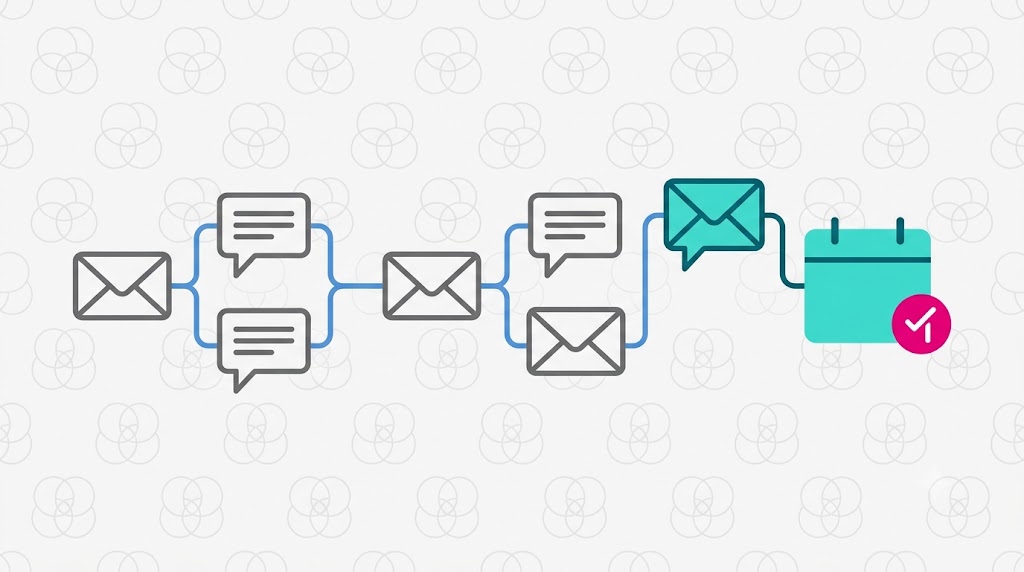
How a Sales VA Handles Appointment Setting
It is 7:40 on a Thursday evening and the sales director of a twenty-person software company is looking at three browser tabs she wishes she had never opened.
The first is her calendar for next week. Four meetings. Her target is twelve. The second is a shared inbox where a demo request arrived at 09:14 on Tuesday from a company that fits the ideal customer profile almost perfectly — right size, right sector, right job title — and nobody has replied to it. Fifty-eight hours have passed. The third is a spreadsheet called warm-leads-Q3.xlsx with sixty-one rows in it, forty of which have not been touched since the trade show in May, and eleven of which are marked “call back Tuesday” without specifying which Tuesday.
Nothing here is a mystery. She knows exactly what should have happened. The demo request should have had a reply inside five minutes and a meeting on the calendar inside fifteen. The trade show list should have been worked in a structured sequence rather than in the gaps between other work. The eleven callbacks should have been diarised the moment they were promised. She could give a competent talk at a conference on all three points.
She did not do any of it, because on Tuesday morning she was running a pricing negotiation, on Tuesday afternoon she was in a QBR, and on Wednesday two of her reps were off sick. The lead did not go cold because anyone stopped caring. It went cold because there was nobody whose entire job was to make sure it did not.
That is the actual shape of the appointment setting problem in most growing businesses. It is not a knowledge problem and it is not a motivation problem. It is a staffing problem wearing the costume of a discipline problem — and the gap between companies that have solved it and companies that have not has become genuinely uncomfortable to look at.
Appointment Setting Is a Job, Not a Task
The phrase “book more meetings” collapses about nine distinct pieces of work into one instruction, which is why it so rarely gets done properly.
Done well, appointment setting is a repeatable operating system with the following moving parts:
List construction and verification. Working out who to contact, then confirming those people still hold those jobs at those companies. This is not glamorous and it is the single largest determinant of everything downstream. Prospeo’s 2026 research puts data quality as the number one problem cited by 43% of SDRs, with 45% saying their existing data is incomplete. Roughly a quarter to 40% of B2B phone numbers go stale within ninety days.
Speed-to-lead on inbound. Getting to a hand-raised prospect while they still have your pricing page open.
Multi-touch outbound sequencing. Cold outreach converts on the sixth to eighth touch, not the first. Industry benchmarks put roughly 80% of conversions beyond the fifth follow-up, and reps need something like twenty-one attempts per contact to reach a decision-maker — up from seventeen a few years ago. Yet the average rep gives up after 1.3 attempts.
Qualification against real criteria. Deciding whether a conversation is worth an account executive’s hour before it is booked, not after.
The booking itself. Time zones, calendar links, invitation accuracy, decision-maker attendance.
Confirmation and show-rate protection. Everything that happens between the booking and the meeting.
CRM hygiene. Logging what happened so the next touch is informed rather than repetitive.
Reschedule and no-show recovery. The 48-hour window after a missed meeting, which most teams simply abandon.
Reporting. Knowing your real conversion rates rather than your assumed ones.
A founder or a closer can do any one of these brilliantly. Almost nobody does all nine consistently while also selling, because the nine are not the same kind of work. Selling is episodic, high-intensity and reactive. Appointment setting is continuous, low-drama and proactive. Ask one person to do both and the continuous work loses every single time, because the episodic work has a deadline and a person on the other end of it.
The tasks that get dropped are never the urgent ones. They are the ones with no external witness — the follow-up nobody is waiting for, the confirmation call nobody asked you to make, the sixty-one row spreadsheet nobody else can see.
The Five-Minute Rule Is Nineteen Years Old and Almost Nobody Executes It
Here is where the numbers start getting hard to explain away.
The canonical research on lead response time comes from Dr James Oldroyd’s Lead Response Management study, run with InsideSales around 2007 across more than 15,000 leads at 100-plus companies. It found that firms contacting an inbound lead within five minutes were roughly 100 times more likely to make contact, and 21 times more likely to qualify that lead, than firms who waited thirty minutes. Four years later, Oldroyd, Kristina McElheran and David Elkington published the academic anchor in Harvard Business Review — “The Short Life of Online Sales Leads” — analysing 1.25 million leads across 2,241 US companies. Responding within an hour made a firm seven times more likely to qualify a lead than waiting one more hour, and sixty times more likely than waiting a full day.
That research is nearly two decades old. Everyone in B2B sales has heard the five-minute rule. Awareness is essentially universal.
Execution has gone backwards.
In 2011, HBR found that 23% of companies never responded to an inbound lead at all. In 2024, RevenueHero submitted demo requests to 1,000 B2B SaaS companies and got a reply from 365 of them. The other 63.5% never responded to a genuine buying signal from a real prospect. Among the companies that did reply, the average response time was one day, five hours and seventeen minutes. A separate 2021 InsideSales analysis of more than 55 million sales activities found that 0.1% of leads received engagement within five minutes, and that 57.1% of first call attempts happened more than a week after the lead arrived.
The non-response rate has roughly tripled in thirteen years while the research explaining why that is expensive became more widely cited than ever.
Sixty-three and a half percent of B2B SaaS companies did not reply to a demo request at all. Not slowly. Not badly. At all.
The close-rate consequence is measurable. Optifai’s benchmark across 939 B2B SaaS companies covering Q2 2025 to Q1 2026 found a 32% close rate when the first response landed inside five minutes, dropping to 24% at five to thirty minutes, 18% at thirty minutes to an hour, 15% within a day, and 12% beyond 24 hours. Moving a lead from the slowest bucket to the fastest roughly 2.6x’s the close rate with no change to the offer, the product or the person selling it.
And the fix is not exhortation. Blazeo’s February 2026 benchmark of 573 companies across six industries found that 35.4% of business leaders say a five-minute response is essential — and 38% of that same group fail to meet the standard they just described as essential. Companies with a written response-time SLA hit the fifteen-minute mark 54.9% of the time; companies without one managed 29.5%. Blazeo’s Aarij Khan framed the finding bluntly: the elite responders are not winning on conscientiousness, they are winning on infrastructure.
There is one more number in that dataset worth sitting with. Over 40% of high-intent enquiries arrive in evenings and weekends, and 77.3% of businesses that respond slowly to after-hours enquiries report losing leads as a result. A company that goes quiet from Friday evening to Monday morning has a sixty-one hour window in which its most motivated prospects get an autoresponder and a competitor gets the meeting.
Why Good Salespeople Still Drop Leads
The reflex when speed-to-lead is bad is to talk to the reps about urgency. The data says that conversation is aimed at the wrong target.
Salesforce’s State of Sales research, now in its seventh edition, puts the average B2B seller at 40% of the week on actual selling — calls, demos, negotiations — with 60% going to admin, CRM entry, internal meetings and prospect research. Gen Z reps sit lower still at 35%, losing roughly two hours a week to manual data entry that more senior reps spend on research and relationships. Forrester’s activity study of 3,031 reps landed in similar territory: about fourteen of fifty-one working hours a week disappear into administration. Nearly two full working days.
Salesforce also found that 72% of sellers feel overwhelmed by the sheer number of skills the job now demands. That is not a soft finding. It is a description of a role that has accumulated responsibilities faster than anyone has removed them.
Then there is the structural churn underneath. Industry benchmarks put SDR turnover around 34% with average tenure of fourteen to eighteen months, against a ramp to full productivity of three to four and a half months. A company running at 34% turnover spends close to a third of each rep’s tenure simply getting that rep productive. Bridge Group’s 2025 data across 351 B2B companies put ramp at 3.0 months, the fastest since 2010 — which is progress, and still means a quarter of a year before a new hire is carrying a full load.
Layer that on top of the base rates. Cold email reply rates have slid from about 6.8% in 2023 to roughly 5.1–5.8% now. Cold call connect rates that ran 15–20% in 2021 sit at 3–10% for most teams. Dial-to-meeting success is around 2.3%. Somewhere between 83% and 84% of reps miss quota consistently, and 78% of sellers missed in 2025, up from 69% the year before.
None of that is fixed by a motivational Monday meeting. It is fixed by putting a dedicated person on the continuous half of the work so the episodic half can be done properly by the people who are good at it.
Booking the Meeting Is Only Half the Job
The most under-measured number in sales development is the one that decides whether any of the booking effort turns into pipeline: the show rate.
The benchmark literature here is genuinely messy, and it is worth being honest about why. RevenueHero’s analysis of 6,428 B2B meetings reported an overall no-show rate of 6.5%, ranging from 1.2% in developer tools to 18.1% in education software. Meanwhile, 2026 B2B SaaS demo benchmarks put median show rates at 62–72%, implying no-shows near a third. Analyses of cold-booked outbound meetings suggest the average climbed from 18% in 2020 to 32% in 2025. These are not contradictory measurements of one thing. They are measurements of different things sharing a label — inbound self-booked demos behave nothing like SDR-booked cold meetings.
What holds across all of them is the direction of the variables, and every one of those variables is an appointment setter’s job:
Booking lead time is the single biggest lever. Same-day bookings show up 82–92% of the time. One to two days out, 72–82%. Three to seven days, 62–72%. Beyond a week, 45–58%. Each additional day between booking and meeting costs roughly three to five percentage points of show rate.
Channel matters enormously. Inbound demo requests show at 75–85%. SDR-booked outbound sits at 55–65%.
Reminder cadence works. A confirmation at booking, a substantive reminder the day before, and a short nudge a couple of hours out is the cadence practitioners keep converging on. Calendly’s own customer data claims around a 28% reduction in no-shows from automated reminders, with 88% of surveyed users reporting a drop — vendor data, so discount it accordingly, but the direction is consistent everywhere.
Recovery is worth running. Rescheduled demos convert to SQL at 18–28%, which compares favourably to the 12–22% first-time-booker rate, largely because both sides arrive better prepared.
Do the arithmetic on a single quarter. A rep booking fifteen meetings a month at a 60% show rate holds nine conversations. The same rep booking thirteen at an 85% show rate holds eleven. Fewer bookings, more pipeline, and the difference is entirely administrative — shorter lead times, disciplined confirmation, and someone who actually rings the no-shows back within 48 hours instead of marking them dead.
A 60% show rate on twenty bookings is twelve conversations. An 85% show rate on fifteen bookings is nearly thirteen. The team that books fewer meetings wins, because someone protected the ones they booked.
The Human in the Loop
The obvious 2026 objection to all of this is that software should have eaten it by now. Autonomous AI SDRs were the breakout B2B sales technology category of 2025, marketed at a few hundred dollars a month as a straight replacement for a human rep. Point it at a market, receive pipeline.
The results have not held up, and the failure modes are specific rather than mysterious.
Deliverability collapse. Practitioner data from Smartlead and Instantly in 2026 shows a median 38-point drop in sender reputation within ninety days of scaling agentic send volume, driven by mailbox providers pattern-matching template homogeneity. Between November 2025 and May 2026 the inbox rules tightened materially: Gmail moved from throttling non-compliant bulk mail to issuing permanent rejections, and Microsoft began enforcing similar standards on Outlook, Hotmail and Live. The complaint-rate ceiling is 0.3%, with Google recommending under 0.1% for stable placement. Cold outbound routinely runs 0.5–1% without aggressive list hygiene. Industry reporting through early 2026 suggests somewhere between 50% and 70% of teams that deployed autonomous AI SDRs churned off them inside three months.
Hallucination at brand-damaging scale. Coldreach’s 2026 review reported 12–18% of generated emails containing at least one factually incorrect company-specific claim; an independent post-mortem on one leading agent put the rate above 20% on a controlled test set. Operators on G2 describe receiving outreach from their own AI agents addressed to employees who left two years ago, referencing product lines that were discontinued and funding rounds that never happened. A 12% error rate against 5,000 daily sends is 600 confidently wrong emails a day, each one screenshot-able.
Regulatory exposure. In February 2024 the US FCC ruled that AI-generated voices count as “artificial or prerecorded voice” under the TCPA, which means marketing calls using them require prior express written consent — not implied consent, not a lawful-interest argument. From 11 April 2025, consumers may revoke consent by any reasonable means, in plain language, with a ten-business-day window to honour it across channels. Closer to home, the Information Regulator’s guidance on POPIA confirms that telephone calls fall within electronic communications, meaning direct marketing by phone requires prior consent unless the limited existing-customer exemption in section 69(3) applies — a meaningful departure from the opt-out posture telemarketers relied on under the Consumer Protection Act. Section 69(4) requires every marketing communication to identify who is sending it and on whose behalf.
None of that is a reason to avoid automation. It is a reason to keep a competent human accountable for the output. Benchmark data across roughly 500 companies found that hybrid approaches — a human rep with AI assistance — convert about 45% better than either AI-only or human-only calling. The pattern that survives is the same one that survived in content and in support: the machine drafts and dials, the person decides and speaks.
The academic work points the same way. In a study published in the Journal of Personal Selling & Sales Management in July 2026, researchers ran five experiments across three selling contexts examining how buyers respond to AI sales agents. The finding was conditional rather than blanket: when the situation signalled clearly that the agent was serving the seller’s financial interest — recommending the pricier option, for instance — customers were willing to pay less for what the AI recommended than for the same recommendation from a human. Where those profit-motive signals were weak, the gap narrowed or reversed. In other words, the more the interaction looks like selling, the more the human premium reasserts itself. Appointment setting is unambiguously selling.
There is also the part no benchmark captures. A trained appointment setter hears hesitation in a voice and knows the difference between “not now” meaning next quarter and “not now” meaning never. They notice that the prospect mentioned a board meeting on the 14th and book around it. They recognise that the gatekeeper who blocked them twice has just been promoted. They know when a lead is worth a fourth attempt and when persistence has become harassment — a judgement call with reputational consequences that no confidence threshold expresses.
Automation is excellent at volume and poor at judgement. Appointment setting is judgement applied to volume. That is precisely the intersection where unsupervised software does the most damage.
The South African Advantage
If the conclusion is that this work needs a dedicated, trained, accountable human, the next question is where that person sits. For businesses selling into the UK, Europe, the Middle East or the US East Coast, South Africa has a set of advantages in this specific role that are not marketing claims but operational arithmetic.
The Time Zone Does the Work
South Africa runs on GMT+2 with no daylight saving adjustment. That places it one to two hours ahead of the UK depending on the season, and inside the full European working day. Nine in the morning in London is eleven in Cape Town. Nine in Frankfurt is nine in Johannesburg. There is a three to five hour overlap with US East Coast mornings.
For appointment setting specifically, that is not a convenience — it is the whole ballgame. Outbound calling, confirmation calls and same-day speed-to-lead all require being on the phone while the prospect is at their desk. The Philippines sits at GMT+8, seven to eight hours ahead of the UK, which means either Filipino night shifts or near-zero live overlap. India at four to five and a half hours ahead overlaps only partially. As Cape Solutions puts it in their comparison of the two markets, outbound calling, appointment setting and consultative SDR work all depend on genuine daytime overlap, and that is exactly the case South Africa is built for.
There is a second-order benefit that shows up in speed-to-lead numbers. A form submitted at 08:20 UK time arrives at 10:20 South African time, into a working day that started two hours ago. The gap between a lead landing and a human replying to it stops being a scheduling problem.
English, Accent and Register
English is a primary business language in South Africa rather than a taught second one. In the EF English Proficiency Index, South Africa scored 602 and ranked 13th globally out of 113 countries in the “Very High” band — first in Africa, ahead of the Philippines and India, and ahead of Japan and most of the Middle East.
The ranking matters less than what it produces on a phone call. South African English reads as neutral to British, Australian and American ears, which reduces friction in the first fifteen seconds of a cold call — the fifteen seconds that decide whether the conversation happens. Buyer preference research tracked by Ryan Strategic Advisory has consistently identified accent neutrality as a contributing factor to South Africa’s rising position in CX delivery rankings.
Register matters just as much for UK and European prospects. British professional communication runs on understatement, hedging and a particular kind of polite persistence. Push too hard and the call ends; push too softly and nothing is booked. South African agents are raised on British and American television, sport and business norms, which means less time coaching cultural calibration and fewer calls that land as slightly wrong in ways nobody can articulate.
Measured Quality and the Attrition Argument
The BPESA and Invest SA GBS Investor Handbook reports that South African providers deliver 18% higher customer satisfaction than comparable operations in India and the Philippines, translating into four to five percent better customer retention year on year.
The number that matters more for appointment setting, though, is attrition. South African contact centres report annual attrition of 10–18% against 30–40% in the Philippines and 30–35% in India. Run the compound effect: an operation at 15% attrition rather than 35% avoids roughly twenty retraining cycles per hundred people every year.
This is decisive in appointment setting because an appointment setter’s value is almost entirely accumulated context. Which objection your market actually raises. Which competitor keeps coming up. Which three companies said “call us in Q4” and meant it. Which prospect’s assistant is the real decision-maker. None of that is in a CRM field. It lives in the head of the person who has been making those calls for eighteen months, and it evaporates every time that person leaves. A cheaper setter who resets that clock twice a year is not cheaper.
Cost Against Quality, Honestly Stated
The cost gap is real and it is large. South African delivery runs 55–65% below US, UK and Australian onshore equivalents, with labour costs 60–80% below UK and US benchmarks.
Set that against the in-house alternative. A fully loaded in-house SDR in the US costs $102,000–$145,000 a year once benefits, tooling, management overhead, recruitment and ramp are counted — and analyses that include the productivity-adjusted cost of a 3–6 month ramp against a 1.4-year average tenure push the figure higher still. Deloitte’s workforce cost work suggests most companies underestimate total cost by 40–50%. UK numbers land in a similar shape once employer NI, pension auto-enrolment, holiday cover, desk and a recruiter’s placement fee at 15–20% of first-year salary are added.
South Africa is not the cheapest option available and it is important to say so. It typically runs 10–20% above the Philippines for equivalent voice roles. The honest argument is that the premium buys time-zone fit, accent neutrality and half the attrition — and that in a role where a mishandled call costs you an account and a mishandled consent record costs you a regulatory problem, the cheapest possible person, unsupervised, on a marketplace, is not a saving. It is an uninsured bet against your own pipeline.
Managed, Not Matched: What Actually Sits Behind the Person
Here is the distinction that decides whether any of this works in practice.
A marketplace hands you a profile and wishes you luck. You become the recruiter, the trainer, the quality assurance function and the replacement plan. When the freelancer juggling eleven other clients stops replying in week nine, you absorb the entire loss — including the onboarding investment, which in appointment setting is substantial because the accumulated context described above took weeks to build.
VAConnect was founded in 2008 as Lime Tree Consulting Solutions by Karen van Zyl, before “virtual assistant” was a term most South African businesses recognised, and rebuilt around the managed model in 2014. It is now Africa’s largest managed VA agency. The managed model means four things sit behind the individual: candidates are sourced through VAJobs.co.za with skills testing, background checks and cultural-fit assessment before a shortlist exists; they are trained through VAVarsity, the internal upskilling platform, before touching a client system; wellbeing and workload are monitored through the Atomic Energy programme; and accountability runs in both directions through VAPIness, the two-way feedback framework.
For a Sales VA specifically, the scope is the nine-part job described at the top of this piece: inbound lead processing and qualification, CRM hygiene across HubSpot, Salesforce or Pipedrive, cold email sequences and LinkedIn outreach, appointment setting, systematic follow-up on stalled deals, re-engagement and win-back sequences, pipeline reporting, and the documentation layer — call scripts, objection-handling notes, handover procedures — that means the knowledge survives a holiday.
The published appointment setter brief is specific about the judgement layer, too: qualified leads are logged with pain points, timing, decision-making authority and budget indicators before they are passed forward, and only qualified leads go through to a sales meeting. That is the difference between an appointment setter and a calendar filler.
The commercial terms follow the same logic. Sales VA engagements start from $1,088 a month. Client retention runs at 98%. If a VA is not performing to the agreed standard, the replacement is free and the transition is managed, so the onboarding investment is not lost — something that has been necessary fewer than eight times in seventeen years of operation. Most matches are filled within two to three weeks.
The client evidence is consistent with the mechanism. A VP of Sales at NovaSpark Technologies, in a verified Clutch review, reported his team closing 30% more deals in a quarter because they were selling rather than doing admin, with the SVA placed fourteen months and counting. A SaaS co-founder describes reclaiming 15+ hours per week in the first month. A maritime software client in Cape Town singled out the thoroughness of the screening rather than the VA’s CV.
The First Ninety Days
Delegating appointment setting is not instantaneous, and any provider who says otherwise is selling something. A realistic shape:
Days 1–14: capture. The VA sits behind the existing process and documents it — the actual ICP rather than the aspirational one, the real qualification bar, the objections that come up, the tools, the calendar rules, the consent position. Output in this phase is mostly CRM hygiene and inbound triage. Meaningful, unglamorous, immediately useful.
Days 15–45: stabilise. Speed-to-lead becomes the first hard commitment, because it is the highest-return operational change available and it requires no new pipeline. Inbound gets a fifteen-minute SLA in business hours. Confirmation and reminder cadence goes live on every booked meeting. No-show recovery starts running as a defined 48-hour play rather than an intention.
Days 46–90: build. Outbound sequences run properly — six to eight touches, multi-channel, tracked. The dormant list gets worked systematically. Reporting shifts from meetings booked to meetings held and meeting-to-opportunity rate, which is where the honest picture lives.
The day-ninety test is simple: can you state your current show rate and your median time-to-first-touch from memory? If you can, the function exists. If you cannot, you still have an intention.
The Gap Is Wider Than It Should Be
What is striking about all of this is not that a competitive advantage exists. It is how ordinary the advantage is.
Nothing described here is clever. Reply to inbound quickly. Follow up more than 1.3 times. Confirm the meeting. Ring the no-show back. Log what happened. None of it requires proprietary technology or a novel methodology. All of it has been documented in the research literature for nearly twenty years.
And yet 63.5% of B2B SaaS companies do not reply to a demo request at all. The average B2B response time is measured in days. Most teams do not track their show rate. The majority of firms that miss the response window believe the window matters. The knowledge is universal and the execution is rare, which means the execution — not the knowledge — is the asset.
That is the uncomfortable conclusion. Two companies with identical products, identical pricing and identical closers can produce completely different revenue, and the whole difference sits in whether somebody’s entire job was to make sure the meeting got booked, confirmed and held. A 32% close rate against a 12% one. Eleven held conversations a month against nine. A 2.6x difference sitting there in the operational layer, entirely available, mostly unclaimed.
The businesses pulling ahead did not find a better tactic. They put a trained, accountable, permanently assigned human on the continuous half of the sales job — and then let their closers close.
DIY vs Generic Freelancer vs VAConnect Sales VA
| DIY / Founder or AE Doing It | Generic Freelancer or AI SDR Tool | VAConnect Managed Sales VA | |
|---|---|---|---|
| Who does the work | Whoever has a gap between meetings | Whoever bid lowest, or an agent with no bid at all | A dedicated, named person assigned to your account |
| Recruitment | Not applicable — you absorb it | You screen, interview and gamble | VAJobs sourcing, skills-tested, background-checked, culturally assessed before shortlist |
| Training | Institutional knowledge in one head | Self-reported skills | VAVarsity before touching your systems; continuous thereafter |
| Speed-to-lead | Best-effort, collapses in busy weeks | Instant but generic, or nothing after hours | Committed SLA inside business hours, GMT+2 covering UK/EU day |
| Time-zone fit (UK/EU) | Yours | Often 7–8 hours out | GMT+2, no DST drift, full working-day overlap |
| Outbound persistence | 1.3 attempts on average | High volume until deliverability collapses | Structured 6–8 touch multi-channel cadence, tracked |
| Show-rate protection | Calendar invite and hope | Automated reminder, no recovery | Confirmation, substantive reminder, 2-hour nudge, 48-hour no-show recovery |
| Qualification | Whoever is free decides | Volume-optimised, quality unmeasured | Logged against pain point, timing, authority, budget before handover |
| CRM hygiene | Retro-fitted on Fridays, sometimes | Fields populated, context lost | Maintained daily across HubSpot / Salesforce / Pipedrive |
| Judgement calls | Excellent, when there is time | None — a threshold is not a judgement | Trained human deciding when persistence becomes harassment |
| Compliance posture | Ad hoc | Vendor liability caps do not transfer your exposure | POPIA-aligned; consent, identification and opt-out handled as process |
| Deliverability risk | Low volume, low risk | Documented 38-point sender-reputation drops at scale | Human-reviewed sending, list hygiene, no volume-for-volume’s-sake |
| Continuity | Breaks on holiday and illness | Freelancer churn; 50–70% AI SDR churn in 3 months | 98% client retention; 10–18% SA market attrition |
| If it is not working | You start again | You start again | Free replacement, managed transition, onboarding investment preserved |
| Cost | Opportunity cost of your best closer’s week | Cheap until it is expensive | From $1,088/month, 55–65% below UK/US in-house loaded cost |
| Ramp | Immediate but never complete | Immediate, no accumulated context | Useful in week one, fully ramped in 2–4 weeks |
Ready to stop losing meetings you already earned?
Book a 30-minute discovery call with VAConnect. We will map your current appointment setting process — inbound response, outbound cadence, show rate — and match you with a Sales VA built for it. Most placements are filled within two to three weeks.