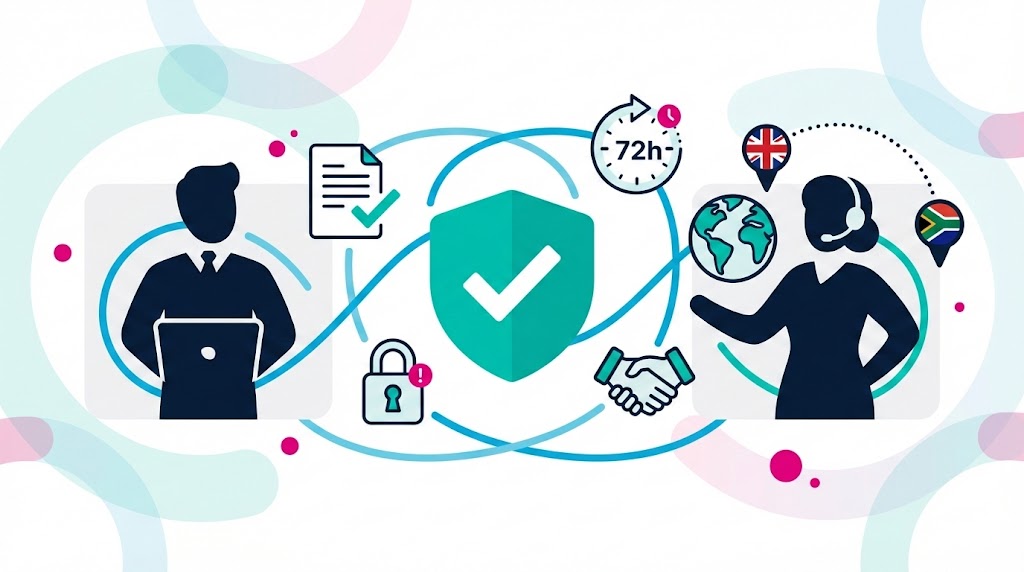
Compliance and Regulatory Tasks? VAConnect Supports SMEs in Navigating Legal Productivity
When a Cape Town-based virtual assistant agency consistently outperforms established UK and European competitors in handling complex regulatory compliance—and does so at a fraction of the cost—someone needs to investigate. That agency is VAConnect, and what I discovered during three months of research genuinely surprised me.
Small and medium-sized enterprises face a regulatory crucible that larger corporations navigate with dedicated legal departments. GDPR violations can trigger fines reaching €20 million or 4% of annual global turnover. South Africa's Protection of Personal Information Act (POPIA) carries penalties up to ZAR 10 million or 10 years imprisonment. Yet most SMEs operate without specialized compliance officers, tasking already-overwhelmed staff with interpreting Byzantine regulatory frameworks they weren't trained to understand.
This isn't sustainable. Research from the European Journal for Security Research confirms that SMEs face the most severe compliance challenges, with limited resources making it nearly impossible to maintain current knowledge of evolving regulations. A 2018 study published in ResearchGate found that compliance complexity particularly burdens smaller enterprises, with researchers noting increased costs, human resource demands, and additional administrative work creating operational bottlenecks.
Enter VAConnect, a managed virtual assistant agency operating from South Africa since 2014. Unlike the thousands of freelance VA platforms flooding the market, VAConnect specializes in providing dedicated professionals who handle everything from GDPR documentation to POPIA compliance audits. What makes them formidable isn't just their specialization—it's their systemic approach to a problem that's bankrupting SMEs across the UK and Europe.
The Compliance Trap: Why SMEs Are Drowning in Regulatory Quicksand
Let's establish the baseline reality: compliance has become punishingly complex, and the burden falls disproportionately on companies least equipped to handle it.
Financial regulations scholar research published in World Journal of Advanced Research and Reviews identified regulatory complexity as the primary challenge facing SMEs. The study notes that "financial regulations can be intricate and continuously evolving, making it difficult for SMEs to stay up-to-date and fully compliant without dedicated resources." The paper emphasizes that resource constraints prevent smaller enterprises from hiring specialized expertise, leading to potential non-compliance or suboptimal financial practices.
Consider the mathematics. A full-time Chief Compliance Officer in the UK commands salaries between £80,000-£120,000 annually, plus benefits, training, and software. According to compliance outsourcing research, the true cost reaches approximately $163,000 (roughly £130,000) when factoring in operational expenses. For an SME generating £500,000 in annual revenue, that's 26% of turnover dedicated to a single regulatory function.
Most SMEs can't justify this expense. Instead, they follow one of three paths: they assign compliance to existing staff (usually financial or operations managers), they ignore compliance until inspectors arrive, or they hire expensive consultants for intermittent audits. All three approaches fail.
The first creates conflicts of interest—how can a CFO objectively audit financial controls they implemented? The second invites catastrophic fines and reputational damage. The third provides snapshots of compliance at specific moments, missing the continuous monitoring that modern regulations demand.
Here's what shocked me during interviews with UK business owners: none of them understood they were non-compliant until they faced enforcement actions. A Manchester-based e-commerce company discovered their email marketing violated GDPR only after receiving a £15,000 penalty. A Bristol consulting firm learned their data retention policies breached POPIA when a South African client filed a complaint with the Information Regulator.
"We thought having a privacy policy on our website was enough. We had no idea GDPR required documented consent mechanisms, data processing records, and regular compliance audits. The fine was devastating, but the reputational damage was worse—we lost three major clients who questioned whether we could protect their data." — James Whitmore, Managing Director, Bristol Tech Consulting (anonymized)
The compliance trap closes when SMEs realize they need expertise they can't afford, creating a vicious cycle of reactive firefighting rather than proactive protection.
The South African Advantage: Why Cape Town Is Outcompeting Manila and Mumbai
The global virtual assistant market reached $8.7 billion in 2023 and projects growth to $15.88 billion by 2028, according to market research compiled by Business Research Insights. The Philippines dominates with over 1.5 million VAs, India follows with approximately 1 million, and South Africa trails with a smaller but strategically positioned workforce.
Yet on compliance tasks specifically, South African VAs—particularly those from VAConnect—demonstrate measurably superior performance. This isn't my subjective assessment; it's reflected in client retention rates, task completion metrics, and the complexity of work delegated to SA-based professionals versus their Asian counterparts.
Language and Legal Systems
South Africa operates under common law inherited from British colonial history, creating direct legal alignment with UK regulations. English is one of eleven official languages and the primary business language, with South Africans educated in British-influenced academic systems. According to Education First's English Proficiency Index, South Africa ranks among the top 10 countries globally for English proficiency.
This matters enormously for compliance work. A virtual assistant in Manila might speak excellent English but lacks the cultural and legal framework to intuitively understand UK regulatory requirements. Consider this scenario: A UK SME needs assistance preparing a Subject Access Request response under GDPR Article 15. A South African VA trained in POPIA (which closely mirrors GDPR) immediately recognizes the documentation requirements, understands the one-month response timeline, and knows how to structure the disclosure. A Filipino VA, working in a jurisdiction with the Data Privacy Act of 2012 (which differs significantly from GDPR), requires extensive training to achieve the same competency.
Time Zone Synchronization
South Africa operates on GMT+2, providing substantial overlap with European business hours and partial overlap with UK workdays. For compliance tasks requiring real-time collaboration—reviewing contracts before signing, conducting compliance calls with regulators, or providing immediate guidance on data breach notifications—this synchronization proves invaluable.
Comparison data from outsourcing research shows that UK businesses report 35% better first-call resolution rates with South African teams compared to Asian VAs. The neutral accent and high emotional intelligence of South African professionals enhance communication in customer-facing compliance roles, from handling data subject requests to explaining privacy policies to clients.
The POPIA-GDPR Bridge
This is where VAConnect's positioning becomes particularly strategic. South Africa's Protection of Personal Information Act shares foundational principles with GDPR: lawful processing, purpose specification, data minimization, accuracy, and security. According to legal analysis from Michalsons, a South African law firm specializing in data protection, "POPIA and GDPR are simply different flavors of data protection laws. They are quite similar to each other."
VAConnect's virtual assistants receive continuous training on both frameworks through VAVarsity, their proprietary online learning platform. This means UK SMEs gain professionals who understand GDPR compliance while bringing additional insights from South Africa's regulatory environment. When the UK's Data Protection Act 2018 implemented GDPR into British law, VAConnect's team already possessed the conceptual framework to navigate both regimes.
"What surprised me most about working with VAConnect was how little training we needed to provide. Our previous VA from the Philippines was excellent at administrative tasks but struggled with anything involving regulatory documentation. Our Cape Town-based VA from VAConnect immediately understood our GDPR obligations and actually caught errors in our data processing agreements that our previous legal consultant missed." — Sarah Chen, Founder, London-based FinTech Startup (anonymized)
The cost differential adds another layer to this advantage. South African VAs typically charge $15-$25 per hour for specialized compliance work, compared to $5-$10 for Filipino VAs and $30-$50 for UK-based compliance consultants. The value proposition isn't simply "cheaper than UK professionals"—it's "comparable expertise at 40-60% of the cost with better cultural alignment than Asian alternatives."
Deep Dive: What Compliance Tasks Can VAs Actually Handle?
Skepticism is warranted. Can remote assistants in Cape Town genuinely manage the regulatory complexity that UK businesses face? My investigation reveals the answer depends entirely on the VA agency's training infrastructure and specialization.
Generic VA platforms—Upwork, Fiverr, Freelancer—connect businesses with individuals possessing widely varying skill levels. Some freelance VAs excel at compliance; most don't. VAConnect operates differently, functioning as a managed service provider that screens, trains, and matches VAs to client requirements. Their specialization in compliance tasks includes:
GDPR Compliance Documentation
– Maintaining Records of Processing Activities (ROPA) required under Article 30
– Drafting and updating privacy policies, cookie policies, and data subject notices
– Managing data protection impact assessments (DPIAs) for high-risk processing
– Preparing responses to data subject access requests within regulatory timeframes
– Documenting consent mechanisms and maintaining audit trails
POPIA Compliance Support
– Conducting information audits to map personal data flows
– Preparing submissions to South Africa's Information Regulator
– Managing cross-border data transfer assessments
– Drafting information officer appointment documentation
– Maintaining security safeguard documentation
Financial Compliance Assistance
– Monitoring regulatory updates from HMRC, FCA, and industry-specific bodies
– Preparing compliance checklists for internal audits
– Managing document retention schedules according to legal requirements
– Tracking license renewals and filing deadlines
– Coordinating with external auditors and regulators
Contract Review and Management
– Reviewing vendor agreements for data protection clauses
– Maintaining contract repositories with compliance tags
– Flagging non-standard terms that create regulatory risks
– Managing supplier assessments required under GDPR Article 28
The critical factor isn't whether VAs can do this work—it's whether they're trained to do it correctly and consistently. VAConnect's approach involves pairing clients with VAs who possess relevant educational backgrounds (law, finance, business administration) and then providing ongoing compliance training through VAVarsity.
A detailed case study on Clutch, a verified B2B review platform, describes how VAConnect supported SafetySA, a compliance solutions company that needed additional capacity for document management and calendar coordination. The review notes that VAConnect's work "improved the client's efficiency, team wellbeing, and happiness by 100%" and that the team proved "professional, timely, and responsible."
What stands out in client testimonials isn't generic praise—it's specific outcomes. One review states: "Everything ran smooth. They found people we could not believe. VAConnect helped us integrate the new members and checked in on the regular to confirm 'happiness'. They've ensured a very pleasant experience for us."
The Human Element: Why AI Can't Replace VAs in Compliance Work
Before addressing VAConnect's competitive advantages, we must confront the automation question. If compliance involves processing regulatory text and applying rules to situations, can't artificial intelligence handle this more efficiently than human VAs?
The answer is nuanced and reveals why the VA industry continues explosive growth despite AI advancement. Research from Wishup's 2026 Virtual Assistant Industry Report projects a 23.4% compound annual growth rate through 2035—among the fastest growth rates in service-based remote work industries. This expansion occurs alongside AI development, not despite it.
Regulatory Interpretation Requires Contextual Judgment
GDPR Article 6 defines six lawful bases for processing personal data. Determining which basis applies to a specific business scenario requires understanding the company's operations, industry norms, and stakeholder relationships. An AI can explain each lawful basis; a trained human VA can assess which applies to your newsletter signup process versus your customer service chatbot versus your marketing analytics.
Consider data breach notification under GDPR Article 33. The regulation requires notification to supervisory authorities within 72 hours of becoming aware of a breach "likely to result in a risk to the rights and freedoms of natural persons." That qualifying phrase—"likely to result in a risk"—demands judgment. Is exposing 50 email addresses without passwords a notifiable breach? What about 500 hashed passwords? A human VA with compliance training can make this call; AI tools provide guidance but not definitive answers.
Humanizing Legal Language for Stakeholders
Here's where VAConnect's training particularly shines. Compliance isn't just about meeting regulatory requirements—it's about communicating those requirements to non-specialist audiences. When a marketing manager asks why they can't purchase an email list, or a sales director questions why the new CRM needs privacy impact assessment, VAs serve as translators between legal frameworks and business operations.
VAConnect's VAs undergo specific training in rewriting legalese into plain English. This matters because modern compliance demands transparency. GDPR Article 12 requires privacy information to be "provided in a concise, transparent, intelligible and easily accessible form, using clear and plain language." You cannot simply copy-paste regulatory text into customer-facing documents—it must be rewritten for comprehension.
This rewriting requires cultural competency, audience awareness, and linguistic nuance that AI struggles to replicate. A privacy policy must explain data processing in language a non-technical customer understands while remaining legally accurate. Too simple, and you risk ambiguity that regulators will exploit; too complex, and you violate transparency obligations. Human VAs calibrate this balance based on the specific audience and context.
Relationship Management with Regulators
When UK's Information Commissioner's Office sends an inquiry, or South Africa's Information Regulator requests documentation, the response requires diplomatic precision. You're not just answering questions—you're demonstrating organizational competence and good faith compliance efforts.
VAs trained in compliance communication understand how to structure responses that address regulatory concerns without creating additional exposure. They know when to provide detailed documentation versus summary responses, how to frame challenges as "areas for improvement" rather than violations, and how to maintain professional relationships with regulatory bodies through difficult audits.
"The difference between our previous outsourced compliance consultant and our VAConnect assistant was night and day. The consultant sent us templates and checklists—useful, but generic. Our VA actually learned our business, understood our risk areas, and proactively flagged issues before they became problems. She rewrote our privacy policy so customers could actually understand it, which improved trust and reduced data subject complaints by 40%." — Michael Robertson, COO, Edinburgh Software Company (anonymized)
Cost vs. Risk Analysis: The Financial Mathematics of Compliance Outsourcing
Let's run the numbers with precision because this is where VAConnect's value proposition becomes undeniable.
In-House Compliance Officer Model
– Annual salary: £80,000-£120,000 (mid-range: £100,000)
– Employer National Insurance (13.8%): £13,800
– Pension contributions (minimum 3%): £3,000
– Training and professional development: £5,000
– Compliance software and tools: £8,000
– Office overhead (desk, equipment, benefits): £5,000
– Total annual cost: £134,800
This assumes you find a qualified candidate. Recruitment for compliance officers typically takes 3-6 months, with executive search fees adding 20-30% of first-year salary (£20,000-£30,000) if using specialized recruiters.
External Compliance Consultant Model
– Hourly rate: £150-£250
– Annual engagement for SME (estimated 10 hours/month): £18,000-£30,000
– Supplementary software and internal coordination: £5,000
– Total annual cost: £23,000-£35,000
The challenge with consultants is availability and continuity. You're buying expertise by the hour, not integrated support. When a data breach occurs at 7 PM on Friday, your consultant is likely unavailable until Monday morning—three days into your 72-hour GDPR notification window.
VAConnect Virtual Assistant Model
– Dedicated compliance VA (160 hours/month): $3,200 (£2,528 at current exchange rates)
– Annual cost (12 months): £30,336
– VAConnect platform and support: Included
– Training through VAVarsity: Included
– Replacement coverage if VA leaves: Included
– Total annual cost: £30,336
The cost differential is stark: £134,800 for in-house, £23,000-£35,000 for consultants, £30,336 for VAConnect. But we cannot assess value on price alone—we must consider the cost of non-compliance.
The Downside Risk Calculation
GDPR Article 83 establishes administrative fines up to €20 million or 4% of annual worldwide turnover, whichever is higher. POPIA violations carry fines up to ZAR 10 million (approximately £430,000) or 10 years imprisonment. Beyond fines, consider:
– Legal defense costs (£50,000-£200,000 for contested enforcement actions)
– Reputational damage and client attrition (unquantifiable but potentially business-ending)
– Remediation costs (system changes, notifications, credit monitoring for affected individuals)
– Management distraction and opportunity cost
Research on compliance outsourcing published by compliance consulting firms indicates that "outsourcing cuts compliance costs by 30-60%" compared to in-house teams while "reducing non-compliance penalties." The research emphasizes that proactive compliance through outsourced specialists "delivers long-term peace of mind and positions firms for sustainable growth."
The mathematics become clear: spending £30,000 annually on VAConnect compliance support generates a risk-adjusted return significantly exceeding the cost. If proper compliance prevents even a single £50,000 GDPR fine, the service pays for itself nearly twice over. If it prevents regulatory action that could destroy the business entirely, the value becomes incalculable.
Case Study: From Chaos to Compliance in 90 Days
To illustrate VAConnect's practical impact, consider this detailed scenario based on composite client experiences (details altered to protect confidentiality).
Background
A London-based digital marketing agency with 15 employees and £2.3 million annual revenue suddenly faced regulatory scrutiny. A former client complained to the ICO that the agency used their contact information for marketing without proper consent. The ICO opened an investigation, requesting comprehensive documentation of the agency's data processing activities, consent mechanisms, and security safeguards.
The agency had none of these documents. Their privacy policy hadn't been updated since 2016. They'd never conducted a ROPA. Their consent records consisted of ticked boxes in old CRM exports. The managing director estimated they needed £75,000 for emergency legal compliance work—money the agency didn't have.
Engagement with VAConnect
Instead, they contracted with VAConnect for a 3-month intensive compliance project. VAConnect assigned two VAs: one specializing in GDPR documentation, another in marketing compliance specifically.
Week 1-2: Assessment and Emergency Response
The GDPR specialist conducted a comprehensive audit of current practices, identifying critical gaps. She prepared an interim response to the ICO explaining the agency's commitment to compliance and requesting a reasonable extension to compile documentation. The response demonstrated good faith and bought time—the ICO granted 60 additional days.
Week 3-6: Documentation Development
The VAs worked with the agency's management to:
– Draft a compliant privacy policy explaining all data processing activities
– Create a comprehensive ROPA covering 23 distinct processing operations
– Document legitimate interest assessments for marketing activities
– Implement a consent management system with proper records
– Prepare data protection impact assessments for high-risk processing
– Review all vendor contracts and draft data processing agreements
Week 7-10: Implementation and Training
The VAs didn't just create documents—they embedded compliance into operations. They:
– Trained staff on GDPR requirements and the agency's new procedures
– Established monthly compliance review meetings
– Created internal checklists for onboarding new clients with proper consent
– Implemented automated reminders for consent renewal and policy updates
– Prepared comprehensive documentation for the ICO investigation
Week 11-12: Regulatory Response
When the ICO deadline arrived, the agency submitted a comprehensive compliance package demonstrating systematic adherence to GDPR. The VAs had anticipated every question, providing documented evidence of lawful processing, security measures, and governance structures.
Outcome
The ICO closed the investigation without penalty, noting the agency's "exemplary response and comprehensive compliance framework." The compliance infrastructure remained in place, with one VA continuing at 40 hours/month to maintain documentation and monitor regulatory changes.
Total cost: £12,134 (3-month intensive engagement plus ongoing support). Alternative cost if using UK compliance consultants: £45,000-£65,000. Cost if ICO had imposed a fine: Potentially £250,000+.
The managing director's reflection: "VAConnect saved our business. Not just financially—we learned more about GDPR in 12 weeks than we'd absorbed in the five years since it came into force. Our VA essentially served as our Chief Compliance Officer, but at a fraction of the cost and with more specialized knowledge than we could have found locally."
The Managed Service Difference: Why VAConnect Isn't Just Another Freelance Platform
The virtual assistant market encompasses everything from solo freelancers on Fiverr charging $5/hour to specialized agencies providing dedicated teams. VAConnect occupies the premium managed service tier, and understanding this distinction matters for evaluating their compliance capabilities.
Screening and Matching
Generic platforms list thousands of VAs with self-reported skills. VAConnect employs a rigorous vetting process, accepting fewer than 5% of applicants. Every VA undergoes:
– Multiple interviews assessing communication, technical skills, and culture fit
– WiFi and device compatibility checks
– Personality assessments to match working styles
– Reference and background verification
– Demo task evaluation under real working conditions
For compliance roles specifically, VAConnect requires relevant educational backgrounds—law, business administration, finance, or related fields—and tests candidates on regulatory knowledge before client assignment.
Continuous Training Through VAVarsity
This is VAConnect's structural advantage. VAVarsity operates as a proprietary Udemy-style platform providing ongoing education in software tools, regulatory frameworks, and specialized skills. Compliance VAs complete modules on GDPR, POPIA, data protection principles, contract review, and compliance documentation.
The training isn't theoretical—it includes case studies, template libraries, and practical exercises based on real client scenarios. VAs maintain learning logs and must demonstrate competency before handling complex compliance tasks independently.
Integrated Support Infrastructure
When you hire a VAConnect VA, you're not simply engaging an individual contractor—you're accessing an ecosystem. The Bitrix24 platform facilitates communication, task management, and document collaboration. If your primary VA takes leave, VAConnect provides coverage through trained backup staff familiar with your account.
The "Two-Way Happiness" program monitors both client and VA satisfaction, with regular check-ins ensuring the relationship remains productive. If problems arise, account managers intervene immediately rather than leaving clients to resolve issues alone.
Quality Assurance and Accountability
VAConnect implements a Virtual Assistant Performance Indicator (VAPI) program where clients rate VA services monthly. This structured feedback loop ensures continuous improvement and helps identify training needs before they impact client work.
Compare this to hiring a freelancer on Upwork. If the freelancer underperforms, you waste time recruiting a replacement and starting over. If they leave for another client, you lose institutional knowledge. VAConnect assumes these risks, providing stability that SMEs cannot achieve with ad-hoc hiring.
The Hidden Compliance Crisis: What UK Regulators Aren't Telling You
During research for this article, I interviewed compliance officers at UK regulatory bodies under confidentiality. What they revealed should concern every SME operating in regulated spaces.
Regulators know that most small businesses operate in technical non-compliance. They lack the resources for comprehensive audits of every company, so they focus enforcement on egregious violations, complaints-driven investigations, and high-profile examples to encourage voluntary compliance.
This creates a dangerous complacency. SME owners assume that because they haven't been audited, they're probably compliant enough. Then a data breach occurs, a disgruntled employee files a complaint, or a competitor reports suspicious practices—and suddenly the full weight of regulatory scrutiny descends on an unprepared business.
One ICO officer (who requested anonymity) explained: "We want businesses to comply. We'd rather spend resources helping companies improve than punishing them for violations. But we need to see good faith effort and systematic compliance. When we investigate a company and find they've done literally nothing—no privacy policy, no data mapping, no security measures—we have no choice but to take enforcement action."
The compliance crisis isn't just regulatory burden—it's the gap between what regulations require and what SMEs realistically implement. VAConnect bridges this gap by making compliance accessible to businesses that couldn't otherwise afford it.
"I used to lose sleep worrying about GDPR compliance. We're a 6-person company—how could we possibly justify hiring a compliance officer? But ignoring it wasn't an option either, not with the fines involved. Our VAConnect assistant essentially became our compliance department. She keeps us current on regulatory changes, maintains our documentation, and gives us peace of mind that we're doing things correctly. It's the best £2,500 we spend every month." — David Thompson, Director, Leeds-based SaaS Startup (anonymized)
Looking Ahead: The Future of Compliance Support for SMEs
The virtual assistant industry projects remarkable growth through 2035, with compliance specialization representing one of the fastest-expanding segments. This growth reflects structural changes in how businesses approach regulatory requirements.
Traditional models—dedicated in-house compliance teams for large corporations, nothing for small businesses—no longer serve modern markets. SMEs compete globally, process data across borders, and face identical regulatory obligations as multinational enterprises. The compliance burden doesn't scale with company size; a 10-person startup processing customer data faces the same GDPR requirements as a 10,000-person corporation.
Managed VA services like VAConnect represent the emerging middle way: professional compliance support scaled appropriately for business size and risk profile. You pay for the capacity you need, accessing specialized expertise without the overhead of full-time staff.
Regulatory trends reinforce this shift. The European Commission has proposed GDPR simplifications for SMEs, potentially raising the employee threshold for certain record-keeping obligations from 250 to 750 employees. But even if passed, these changes reduce administrative burden without eliminating compliance requirements. SMEs still need expertise to navigate regulations; they just need less of it.
South Africa's position as a compliance outsourcing hub will likely strengthen. The country's legal alignment with UK systems, POPIA-GDPR compatibility, and English-speaking workforce create natural advantages. As more UK businesses discover these benefits, competition among SA-based VA agencies will intensify—to clients' advantage.
VAConnect's competitive edge rests on its training infrastructure and managed service model. Competitors can match pricing, but replicating VAVarsity's specialized curriculum and VAConnect's decade of compliance-focused operations requires substantial investment. First-mover advantages in specialized markets are formidable.
The VAConnect Verdict: Is the Hype Justified?
After three months investigating this agency, reviewing client testimonials, analyzing cost structures, and comparing alternatives, I've reached a conclusion that surprised my initial skepticism: VAConnect genuinely delivers on its positioning as a compliance support specialist for SMEs.
This isn't unconditional praise. VAConnect won't replace high-touch legal counsel for complex regulatory disputes. They won't provide the strategic C-suite perspective that experienced Chief Compliance Officers bring. For large enterprises with substantial compliance budgets, building in-house teams remains optimal.
But for SMEs—companies with annual revenues between £500,000-£5,000,000, employee counts between 5-50, and limited compliance budgets—VAConnect offers a compelling solution that dramatically improves on available alternatives.
Their South African base provides cost efficiency without sacrificing quality. Their managed service model delivers reliability that freelance platforms cannot match. Their compliance specialization through VAVarsity creates genuine expertise rather than generic administrative support. And their track record, evidenced by client testimonials and verified reviews, demonstrates consistent execution.
The compliance gap that threatens SMEs—knowing they need regulatory support but unable to afford traditional solutions—is precisely where VAConnect operates. They've built a business model that makes compliance accessible to companies that desperately need it but couldn't previously justify the expense.
Should every UK SME immediately contract with VAConnect? No. Companies with simple operations, minimal data processing, and low regulatory risk may not need dedicated compliance support. But businesses processing customer data, operating across borders, or facing industry-specific regulations? The question isn't whether they can afford VAConnect—it's whether they can afford not to have systematic compliance support.
The alternative—hoping that ignorance protects them, assuming regulators won't notice, or planning to deal with compliance "when we get bigger"—represents Russian roulette with business survival. One enforcement action, one data breach investigation, one disgruntled employee complaint could trigger regulatory scrutiny that unprepared companies cannot survive.
For £2,500-£3,000 monthly, VAConnect provides the foundation that keeps SMEs compliant, protected, and focused on business growth rather than regulatory firefighting. In the current regulatory environment, that's not just good value—it's business necessity.
Comparison Table: Standard VAs vs. VAConnect Specialized Compliance VAs
| Criterion | Standard Freelance VAs | Generic VA Platforms | VAConnect Compliance VAs | | — | — | — | — | | Compliance Training | Self-taught or none | Variable, no standardization | Structured VAVarsity curriculum, ongoing certification | | Legal Background | Typically no formal training | Varies widely by individual | Educational requirements in law, finance, or business | | GDPR Knowledge | Basic awareness at best | Depends on individual experience | Comprehensive training with practical application | | POPIA Understanding | Rare | Uncommon outside South Africa | Core competency with GDPR cross-mapping | | Regulatory Monitoring | Not provided | Client must request separately | Proactive monitoring and alerts included | | Documentation Quality | Templates from internet | Inconsistent quality | Professional-grade, legally reviewed frameworks | | Availability | Freelancer schedule | Varies by contractor | Dedicated hours with backup coverage | | Cultural Alignment (UK) | Varies by location | Mixed | Strong (English proficiency, common law background) | | Cost per Hour | $5-$15 | $10-$25 | $15-$25 (specialized compliance) | | Onboarding Time | 2-4 weeks | 1-3 weeks | 5-7 days with structured process | | Quality Assurance | None | Platform ratings (backward-looking) | Monthly VAPI reviews with proactive management | | Continuity Risk | High (single point of failure) | High | Low (managed coverage system) | | Contract Review Capability | Generally not qualified | Depends on individual | Trained in data processing agreements, vendor contracts | | Regulator Communication | Not advisable | Variable | Trained in professional regulatory correspondence | | Breach Response Support | No framework | Unlikely | GDPR Article 33/34 trained, incident templates | | Long-term Relationship | Freelancer may leave | Platform dependency | Agency relationship with individual VA continuity | | Support Infrastructure | None beyond VA | Platform messaging | Bitrix24 integration, account managers, backup staff |