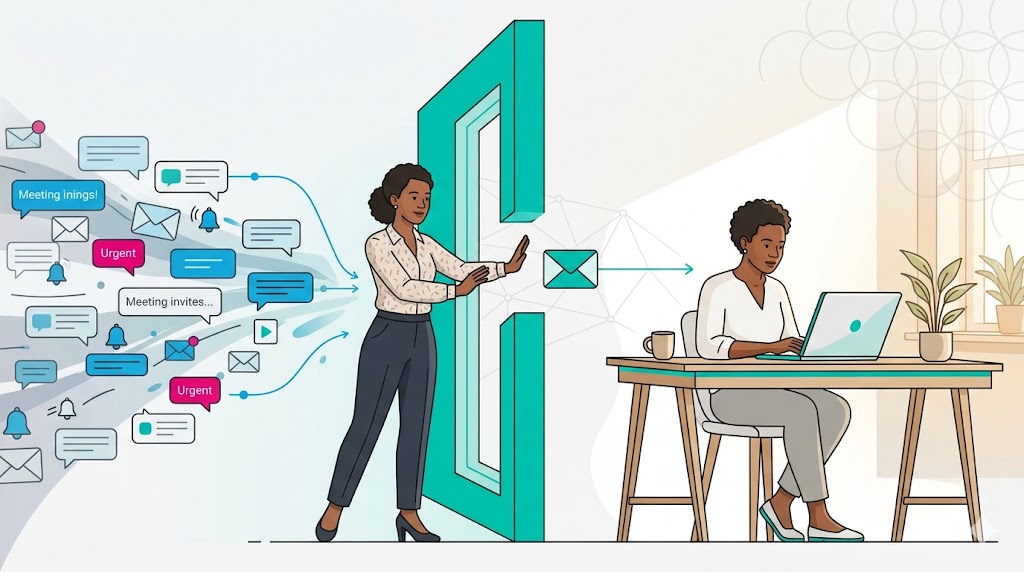
There is a particular kind of exhaustion that doesn’t come from doing hard work. It comes from never getting to the hard work at all.
You know the shape of the day. You sit down at 8 a.m. with one important thing you need to finish — the strategy doc, the investor update, the hiring decision that’s been waiting a week. Then the first message arrives. Someone needs “five minutes.” A meeting invite lands for a call you don’t recognise. Three emails come in marked urgent, none of which are. By the time you surface, it’s 4 p.m., you’ve answered forty-seven things, and the one thing you actually sat down to do hasn’t been touched. Again.
VAConnect’s own page for executive support names this almost word for word: if you’re feeling stressed at work with too many meeting requests, emails, and new projects flooding your desk, it’s time to hire your own executive assistant. It’s a familiar feeling because it’s nearly universal among people who run things. And it has a name that sounds almost quaint until you’ve lived it: a lack of gatekeeping.
This piece is about what gatekeeping and prioritisation actually look like when a trained executive VA does them well — not the receptionist caricature of “screening calls,” but the real, daily craft of deciding what reaches you, when, and in what order. It matters more than most founders realise, because the cost of getting it wrong is no longer a vague sense of busyness. It’s measurable, and the numbers are worse than you’d guess.
The Real Price of an Open Door
Start with the interruption itself. The most-cited figure in this whole field comes from Gloria Mark’s research at UC Irvine, and it has aged into something close to received wisdom: it takes an average of 23 minutes and 15 seconds to get back on track after a distraction. That’s not 23 minutes lost to the interruption. That’s 23 minutes lost after it ends, clawing your way back to where your head was.
Now layer on how often it happens. Knowledge workers are interrupted every 6-12 minutes on average, and each switch forces the brain to reorient, reload mental models, and fight off lingering attention from the previous task. The math doesn’t reconcile — you cannot recover focus that takes 23 minutes to rebuild when you’re interrupted every 11 — and that irreconcilability is the problem. Most people running a business never reach deep focus at all. They live in the ramp-up, perpetually reloading.
The newest data makes the old numbers look gentle. Microsoft’s analysis of trillions of productivity signals found that during core work hours, employees face a ping — from meetings, emails, or chats — every two minutes, which adds up to 275 interruptions over a full day. And the cognitive toll isn’t just lost time. A 2024 study found that heavy multitasking temporarily reduces IQ by up to 10 points — a larger cognitive impairment than losing a full night of sleep.
Every “quick question,” every impromptu check-in, every meeting that could have been an email costs 23 minutes of recovered focus. Multiply that across your week, and the open door isn’t generous. It’s the most expensive thing in your business.
Read that back and the picture sharpens: the leader with no gatekeeping isn’t just busy. They’re making decisions all day in a state of measurable cognitive impairment. The whole point of an executive VA’s gatekeeping function is to put a wall between you and that state.
Gatekeeping Is Not Saying No to People
Here’s where the word “gatekeeper” does damage. It conjures someone cold at a front desk, blocking access, making people feel small. That’s not it, and the assistants who do this best are emphatic about the distinction.
One veteran assistant framed it as a question that answers itself: is gatekeeping about blocking access and stopping the communication flow, or is it about scheduling, prioritising, good planning and effective time management? The honest answer is the second one. Good time management is about spending time on what is important. A gatekeeper who simply says no to everything isn’t protecting the executive; they’re isolating them, which is its own failure.
The skill is directional. The same assistant described it precisely: the less skilful an executive is at managing down, the more skilful an assistant needs to be at managing up. Gatekeeping done well means routing the right things to you faster, not just keeping things away. The renewal issue that needs your call today gets pushed up. The “can we grab 30 minutes to align” request that’s really a status update gets answered by your VA with the document that makes the meeting unnecessary. Same gate. Opposite outcomes, depending on what’s standing in front of it.
This is why the industry’s language for the role has shifted. The modern executive assistant is described less as a filter and more as a strategic buffer — someone who, by shielding leaders from low-priority distractions and optimising their schedule, enables higher quality thinking, stronger stakeholder relationships, and sharper decision-making. The gate is in service of your judgment, not a substitute for it.
The Triage Engine: How Prioritisation Actually Works
If gatekeeping decides what reaches you, prioritisation decides in what order. And good prioritisation is less about willpower than about a working system that runs whether or not you’re paying attention to it.
The mechanics are unglamorous and that’s the point. A skilled executive VA filters requests, batches similar meetings, and builds focus blocks so leaders can do deep work instead of reacting to every invitation. The practical pieces are concrete: setting recurring review sessions, creating clear meeting rules, and using triage principles for conflicting requests. When two things both claim to be urgent, someone has to decide — and if that someone is you, every time, then you’ve simply moved the interruption upstream.
The deepest move in prioritisation is the one most founders resist: cancelling. As one leadership writer put it bluntly, the back-to-back-meetings problem isn’t a time management problem; it’s a priorities problem disguised as a time management problem. Look at next week’s calendar honestly and ask how many meetings exist only because someone once added you to a recurring invite and you never questioned it. An executive VA questions it on your behalf. They send the message — I don’t think I need to be in this anymore; let me know what you need and I’ll get it to you another way — and as that writer notes, most people won’t even notice you’ve stopped coming, and the ones who do will tell you what they actually need, which is usually a five-minute conversation, not a one-hour meeting.
The leader drowning in meetings doesn’t have a scheduling problem. They have a priorities problem wearing a scheduling costume. A good VA’s first job is to tell the two apart.
The same logic applies to status meetings, which are pure prioritisation waste. If a recurring call is just people taking turns reporting, your VA can convert it: “Can everyone send a quick update by Tuesday morning instead of meeting? I’ll compile it and send it round.” A one-hour meeting becomes ten minutes of reading. And then there’s the part almost no overloaded founder protects without help — thinking time. The discipline is simple and nearly impossible to do for yourself: block out one hour, twice a week, mark it as busy, and treat it like a meeting with yourself that you really can’t cancel. A VA holds that line when you won’t.
Done together, these moves are why senior assistants are now described as time multipliers rather than time managers. Managing an executive’s schedule isn’t about filling time slots — it’s about maximising productivity and ensuring the right priorities are front and centre.
The Human in the Loop: Why Triage Resists Full Automation
It’s a fair question in 2026: can’t software do this? Your inbox already has priority filters. AI can summarise threads, draft replies, even suggest what to decline. So why pay for a person to stand at the gate?
Because the gate is a judgment problem, and judgment is exactly where automated triage is thinnest. A rules-based filter can sort by sender or keyword. What it cannot do is know that the politely worded email from a junior client contact actually signals a contract about to wobble, or that the “no rush” message from your biggest investor is the one thing you should drop everything for. That reading sits on context the software doesn’t have — your relationships, your quarter, the deal you mentioned in passing on Tuesday. The current generation of AI assistant tools is useful precisely as a tool: leaders are advised to prioritise calendar and email integrations and AI summarisation, while learning to configure prompts and validate AI outputs. Note the word validate. Someone still has to check the machine’s work, and that someone needs to understand your business.
There’s a relationship cost to pure automation, too. Gatekeeping is human contact at the boundary of your attention — the person whose email gets auto-declined feels managed by a machine, while the same decline delivered with warmth by your VA preserves the relationship. One account of this captured the balance well: an executive whose team was scattered across five time zones had meetings starting at 5 a.m. and running past 10 p.m., until her assistant acted as a gatekeeper and ensured clear boundaries for both her team and herself, making every team member feel seen and heard while protecting her calendar. Protected and heard. An automated filter can do the first half. It cannot do the second.
This is the heart of what VAConnect calls the managed model rather than a freelancer marketplace. The point isn’t a person instead of software — your VA uses the software, fluently. The point is a trained human directing those tools with judgment, so the technology amplifies discernment instead of replacing it with rules. The brittle part of triage is the part that needs a person. The volume part is the part software handles. A good executive VA runs both at once.
The South African Advantage
If gatekeeping is fundamentally about protecting your hours, then when your assistant works becomes a structural question, not a detail. This is where South Africa’s position turns out to be unusually well-suited to UK and European businesses.
The timezone alignment is the quiet superpower. South Africa sits at GMT+2, which means a near-complete overlap with the UK and a full overlap with continental Europe through the working day. Industry analysis of the country as an outsourcing base highlights exactly this: the GMT+2 position gives near-complete UK and EU overlap. For gatekeeping, that’s everything. Your VA isn’t catching up on yesterday’s chaos when they log on — they’re standing at the gate in real time, fielding the 9 a.m. request before it becomes your 9:15 problem. No waiting overnight for the inbox to be triaged. No 5 a.m. or 10 p.m. calls. The day is screened as it happens.
Language is the second pillar, and it matters more for gatekeeping than for almost any other VA function. Your assistant is speaking and writing as you, or close to it — declining meetings on your behalf, replying to clients, managing the tone of a hundred small interactions that shape how your stakeholders feel. South Africa consistently ranks among the top tier of English-proficient nations, with a large pool of university-educated, native and near-native English speakers and a neutral accent that reads as natural to British and European ears. When the gatekeeper’s whole job is communication, fluency isn’t a nice-to-have; it’s the product.
A VA in your timezone who writes in your voice isn’t an offshore cost saving with a catch. For a UK founder, it’s closer than the freelancer two postcodes away who only checks Slack twice a day.
Then there’s cost, and the figures are genuinely striking — South African talent typically delivers savings in the range of 50 to 65 percent against equivalent UK or US in-house hires. But the framing matters. The South African advantage isn’t cheap labour; it’s the rare combination where the cost saving and the quality move in the same direction. Cultural affinity with Western business norms, strong written English, a professional services tradition, and timezone fit mean you’re not trading quality for price. You’re getting both, which is precisely the gap that VAConnect built its model around closing.
Why a Managed VA Beats a Solo Freelancer at the Gate
Here’s a scenario that exposes the difference. Your VA — the one who knows your priorities, your key relationships, your sense of what’s urgent — gets sick for a week. Or simply takes leave. With a solo freelancer, the gate is now unmanned. Everything floods straight back to your desk, and you’re back to 8 a.m. with a strategy doc and no chance of finishing it.
This is the structural weakness of hiring an individual freelancer for a role whose entire value is continuity and context. Gatekeeping is built on accumulated knowledge — the VA who’s learned, over months, that this client always sounds urgent and never is, while that one understates everything. A freelancer marketplace gives you a person; it doesn’t give you backup, training, or a guarantee that the institutional memory survives a bad week.
VAConnect’s managed model is built around exactly this gap. Founded in 2008 and rebranded as a managed virtual assistant business in 2014, the company describes itself as small enough to care, big enough to guarantee quality and stability — and that phrase is doing real work. Behind your individual VA sits recruitment, training through the company’s own VAVarsity upskilling platform, performance management through the Two-Way Happiness programme, and backup cover so the gate stays manned. The “Strategy First” onboarding means your VA learns your priorities deliberately, not by trial and error. With 250,000+ hours delivered, a 35-plus-strong team, and a grand total of two bad reviews on record, the track record points the same direction: gatekeeping is a long game, and continuity is the whole point.
It’s also why VAConnect resists the “matched, not managed” freelancer framing. A matched freelancer is a transaction. A managed VA is a relationship with infrastructure underneath it — which, for a function defined by trust and accumulated context, is the difference between a gate that holds and one that’s only as reliable as one person’s calendar.
What Good Gatekeeping Frees You to Do
Step back from the mechanics and the real benefit comes into focus. The aim was never simply fewer interruptions. It’s what the protected hours are for.
When the gate holds, you get back the thing the data says most leaders never reach: uninterrupted depth. The strategy that needed three clear hours gets three clear hours. The hiring decision gets your full judgment instead of a distracted yes. The relationships that actually move your business get tended, because your VA pushed them to the front of the queue while quietly absorbing the noise behind them. This is why the role has been reframed across the industry from administrative support to strategic partnership — the modern EA is increasingly embedded in leadership, anticipating, communicating, coordinating, and executing, influencing everything from executive output to team culture.
The shift is from reactive to deliberate. Without a gatekeeper, your day is authored by whoever messages you most aggressively. With one, your day is authored by your priorities, and everything else routes through someone whose job is to know the difference. That’s not a luxury for the very large. It’s arguably most valuable for the founder still doing everything alone — the one for whom every unscreened interruption is a direct tax on the work only they can do.
The Gap, Side by Side
The clearest way to see the difference is to put the three common approaches next to each other and ask what actually happens at the gate.
| Dimension | DIY Coordination | Generic Freelancer | VAConnect Managed Executive VA |
|---|---|---|---|
| Who guards your focus | No one — every request hits you directly | A person, but with shallow context | A trained VA who knows your priorities and relationships |
| Interruption handling | You absorb all 275 daily pings yourself | Some screening, inconsistent judgment | Real-time triage; only what needs you reaches you |
| Prioritisation method | Reactive — loudest request wins | Ad hoc, depends on the individual | Systematic triage, recurring reviews, protected focus blocks |
| Managing up | Impossible — you are the bottleneck | Limited; freelancer rarely pushes back | Actively routes the right things to you faster |
| Meeting discipline | You attend everything by default | Books what you ask, rarely questions it | Cancels, converts, and defends thinking time |
| Timezone fit (UK/EU) | N/A | Variable, often misaligned | GMT+2 near-complete UK/EU overlap |
| Communication quality | Your own (when you have time) | Variable English, variable tone | University-educated, native/near-native English in your voice |
| Continuity if VA is away | You’re back to doing it all | Gate goes unmanned | Backup cover and managed handover |
| Improvement over time | None — same overwhelm | Static | Continuous upskilling via VAVarsity |
| Cost vs UK/US in-house | Hidden cost: your lost deep work | Cheap but inconsistent | 50–65% saving with no quality trade-off |
| Underlying relationship | You alone | Transactional | Managed partnership with infrastructure |
The honest read on that table is a little uncomfortable. The gap between a business whose leader’s attention is actively protected and one whose leader is the open door has grown wider than most founders want to admit — not because the overwhelmed founder works less hard, but because they spend the whole day in the 23-minute recovery zone and never reach the work that compounds.
Gatekeeping and prioritisation sound like small administrative functions. They are, in fact, the difference between a calendar that runs you and one you run. A trained executive VA — in your timezone, in your voice, with a managed team behind them — is how you close the gate and finally get back to the work you sat down to do at 8 a.m.
Ready to put someone capable at the gate? Book a strategy-first discovery call with VAConnect and find out what a managed executive VA could hand back to your week.